- Retro XP
- Posts
- It's new to me: Basketball (Atari 2600)
It's new to me: Basketball (Atari 2600)
Atari turned its eyes toward basketball in 1978, and truly launched the sport in video game form.

Marc Normandin
December 03, 2025
This column is “It’s new to me,” in which I’ll play a game I’ve never played before — of which there are still many despite my habits — and then write up my thoughts on the title, hopefully while doing existing fans justice. Previous entries in this series can be found through this link.
Atari’s 1978 game, simply named Basketball, was not the first basketball video game. At least, not officially. The Magnavox Odyssey, the first video game console, had a basketball game in 1973, though, this title (also named Basketball) was a TV overlay with lights. Taito had a basketball game in arcades a year later, TV Basketball — the first to use character sprites to represent human characters in a game.
Unofficially, though, Atari’s take was the first game to feel something like basketball. The side-view setup might have looked similar, but you couldn’t dribble the ball on the Magnavox Odyssey²’s attempt at pure video game basketball — named Basketball! to switch things up — which released the same year as Atari’s first attempt at the sport. TV Basketball had some of the trappings of the game, but was more like a Pong variant than basketball itself. Atari’s Basketball wasn’t the first, no, but it was the one that figured things out for adaptations of the sport in video game form, thanks to the introduction of a computer-controlled opponent and a true differentiator from basketball’s video game past to that point: dribbling.
That might not sound like much, but again, this was 1978. The system that Basketball released on, the Atari VCS — or 2600, depending on where in time you’re discussing it — came out in 1977. Taito’s Space Invaders released the same year in arcades, in black and white, and was and is so alien to what existed at the time and since that it exists outside of the history it helped create. These were early days — implementing a dribble and having it work as this major achievement sounds prehistoric here in 2025, but yeah, this was some dawn of history-era development here.
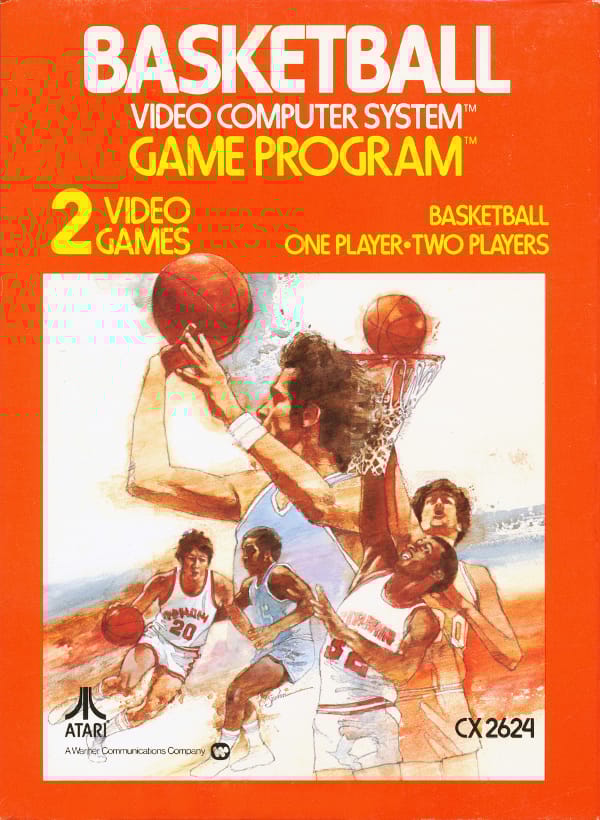
Image credit: Atari Mania
Thankfully, we can see what the basketball games to that point looked like, to give you a sense of how different — and more in line with the basketball games to come — Atari’s effort was. There are Let’s Play videos for Magnavox Odyssey games, courtesy the University of Pittsburgh’s OdysseyNow research project, for instance, which helps if you’re having trouble conceptualizing what a TV overlay basketball game with lights would even look like.
And then there’s Taito’s TV Basketball, designed by Tomohiro Nishikado, the future creator of Space Invaders. It’s black and white and in arcades, and has you controlling human-shaped character sprites in a line, attempting to knock a perpetually bouncing ball that does not, in any way, shape, or form exhibit the physics of a basketball, into the hoop. What if Pong was turned sideways, and the size of the goal shrunk? That’s TV Basketball, which Nishikado even admitted was what he did in order to make it feel “fresh and new”.
The Odyssey²’s Basketball! was significantly different from the original TV overlay property, and it utilized a side view as well as a level of player control that didn’t exist in TV Basketball. However, the physics were still pretty wonky, and dribbling wasn’t an option — check the way the ball and the player move here.
The hoop is also a little funny, since you have to get the shot up and into the basket, but what you really need to do is get it to make its way through the hoop horizontally — sure, it might feel that complicated sometimes when your shot keeps going in and out of the basket, but that’s not how things really work in basketball.
Which brings us to Atari’s Basketball. Here, you don’t just have a side view like with TV Basketball and Basketball!, but it’s also angled to create what looks like a 3D space to move around in, and, through control of a joystick, your sprite can move within it in 8 directions. Because you’re doing more than moving just side-to-side (or jumping up and down), dribbling was required: you need to chart a path to the basket, just like you would in actual basketball, and you can blow right by a defender or be intercepted by them, depending on their positioning and their own movements.
It’s still very simple of course, but considering what came before, it was revolutionary in a way that should be obvious just from watching a 30-second clip:
Sure, there isn’t a three-point line — hell, the NBA didn’t even implement that until 1979, a few years after the merger with the ABA, so why would it be here? — and the computer opponent seems literally incapable of missing a shot no matter where they take it from, but there is so much more going on here as far as basketball goes compared to the game’s predecessors. You hold down the shot button longer to change the angle of the shot, which allows you to fire one off at a high arc that’s going to be difficult to defend, and you can steal the ball either as part of a block as a shot is first released, or by crowding your opponent on defense while they dribble. Considering that the computer opponent is, as said, hitting their shots from anywhere like they’re a Larry Bird highlight reel, you’re going to need those steals to avoid falling behind.
The game’s manual was helpfully preserved in Digital Eclipse’s Atari 50 collection from 2022, which includes Basketball as part of one of its downloadable content packs.
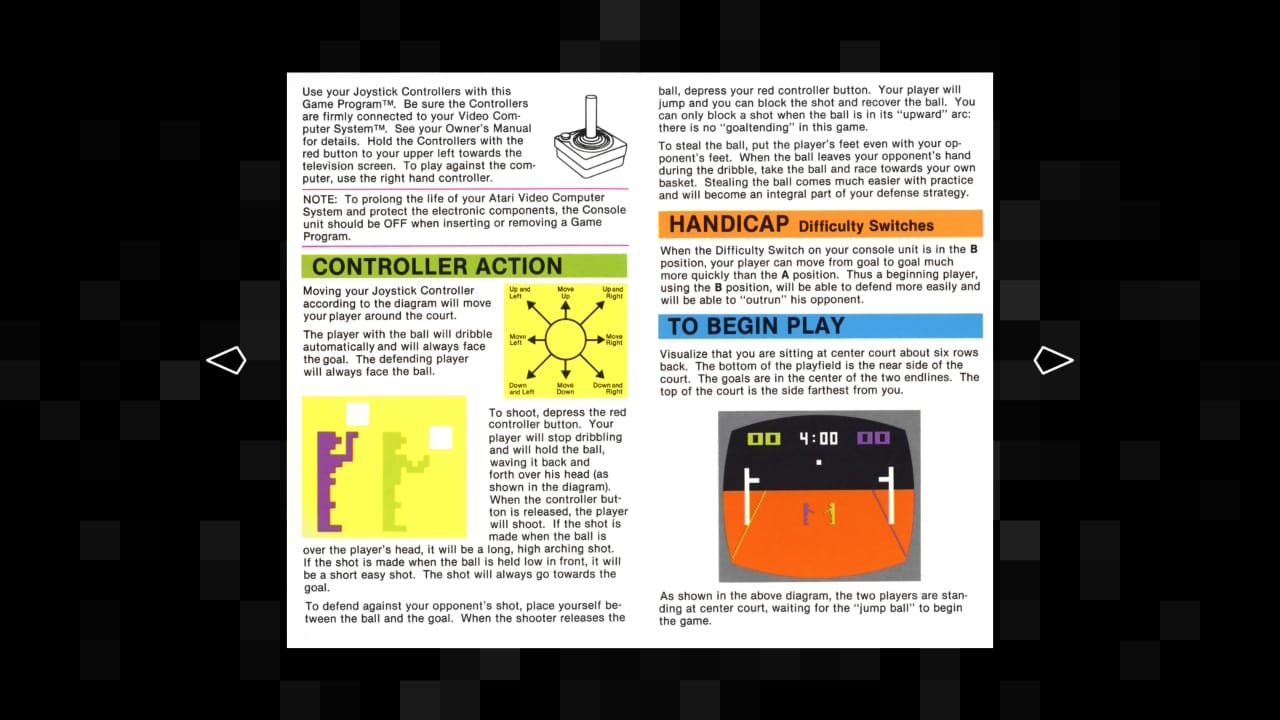
The manual is basically just art, these two interior pages, and a back cover, but it has all you need to know about Basketball contained within.
“To defend against your opponent’s shot, place yourself between the ball and the goal.” See, it really is basketball.
Each game is four minutes long — you can ignore the zero after the first number in the timer in the top-center of the screen, which, in the thumbnail to the embedded video above, makes it look like 10:38 remains in the game when it’s actually 1:38. Which is plenty of time, considering the speed at which things move: to reference the thumbnail again, less than three minutes into the game, the score was 48-46. You are always moving, as you have to be in order to keep your opponent from having a wide-open shot they are 100 percent going to sink, and the game automatically resets your position after a basket. So, you shoot, score, and then teleport back to your basket to begin defending it as your opponent similarly teleports to their side with their ball in their hand. You are always facing the direction you need to be for what you are doing at that time, with your back to the basket and face to the ball on defense, and your face to the opponent’s hoop on offense.
Dribbling is automatic — unlike in Konami’s 1984 arcade game, Super Basketball, in which dribbling was a thing you had to do yourself in order to move — so you don’t have to worry about that part of things, but in order to steal the ball there is some action required. You have to align yourself just right with your opponent, and then basically race by them — you’ll have to imagine the act of ripping it out of their hands, but that’s what you’re doing. Sometimes the two of you are still lined up just right in a way that sees the ball go back-and-forth quickly, or your steal is immediately met by a counter-steal and then they take off with the ball again to avoid a repeat, but you get used to the feel of it all as you play more, too.
There are also multiple difficulties, which have you moving faster or slower, depending. When set to the “B” position, you move more quickly, which will let you catch up and defend even when you take a poor route. With the Atari VCS’ difficulty switch in the “A” position, you move slower, and have to be much more efficient with your routes and better about your decision-making.
If you have never played Atari’s Basketball, it’s still possible that you’ve seen it in action somewhere besides in newsletters or articles on the internet. It has a cameo in the 1980 Zuckers brothers movie, Airplane!, a disaster comedy starring Leslie Nielsen and NBA star Kareem Abdul-Jabbar, among others. It briefly shows up as the flight controllers are supposedly doing their jobs, attempting to track the titular airplane — they’re working, sure, but they are also playing Basketball on one of the giant monitors that’s supposed to have something more important on it mid-disaster.
The funny thing about Abdul-Jabbar being in a movie featuring Basketball as part of a gag is that he was also in Atari’s commercials for the game.
Atari wouldn’t just go one-and-done with Basketball. Instead, in 1979, they released a computer version of the game with improved graphics, where the character sprites were wearing clothes and had basic faces, the court had lines painted where they were supposed to be, and also the baskets actually looked like baskets, with backboards and defined nets. They would also release an arcade game, Atari Basketball, in 1979, where the more powerful hardware allowed for even more detailed sprites and the side-view angle was further emphasized as being a view from slightly above, but it was no longer in color. Again, that was normal for the time — Space Invaders didn’t originally release in color, and that thing was a Star Wars-level cultural event on multiple continents.
Basketball games would rapidly progress after Atari’s introduction of this angle, dribbling, a computer opponent when you didn’t have a friend to play against, and a touch of defensive complexity. Intellivision would release a 3-on-3 basketball game, NBA Basketball — the license only extended to the name, not anything within the game itself — in 1980. One on One: Dr. J vs. Larry Bird would come out on multiple platforms starting in 1983, and featured players licensing their likenesses out for the first time. Konami would release Super Basketball in arcades in 1984 with its highly-focused crunch time gameplay hook, and then Double Dribble was not far behind. More and more developers started focusing on making basketball games, and while it never took off to quite the degree that baseball games did in terms of sheer quantity or variety, this leap in popularity certainly arose out of the progress Atari made with Basketball between 1978 and 1979. It’s a simple game, sure, but it’s an important one.
This newsletter is free for anyone to read, but if you’d like to support my ability to continue writing, you can become a Patreon supporter, or donate to my Ko-fi to fund future game coverage at Retro XP.
Reply