- Retro XP
- Posts
- It's new to me: Final Zone
It's new to me: Final Zone
Wolf Team gets it right — mostly — with the third and final entry in this series.

Marc Normandin
March 25, 2026
This column is “It’s new to me,” in which I’ll play a game I’ve never played before — of which there are still many despite my habits — and then write up my thoughts on the title, hopefully while doing existing fans justice. Previous entries in this series can be found through this link.
Before Wolf Team was known for role-playing games with action-oriented combat and complicated, layered systems — your Tales of Phantasia and, after exiting Telenet, Star Ocean — it made straight-action games with… well, complicated, layered systems. These did not always work out, as sometimes Wolf Team’s push for innovation got in the way of refining the feel and balance of it all, but given enough chances, they would get things just right. Or at least pretty close to it, in the case of Final Zone, which is actually the third and final game in a series.
The original Final Zone was released in 1987 for Japanese computers, and while it had some big ideas, in practice it was a run-and-gun where there was little reason to bother fighting at all because of the way the game was designed. The second entry, Final Zone II, was developed for the PC Engine CD and TurboGrafx-CD in 1990 by another group at Telenet besides Wolf Team, and featured shooting in eight directions (rather than forward only); while that game has its own issues, it also introduced power suits — NAP suits, which stands for “New Age Power Suit.” These equipped two different weapons, a primary and a secondary, with the first having unlimited ammo and weaker shots, the second limited shots but more devastating ones.
Also in 1990 was Wolf Team’s second attempt at making something out of this Final Zone idea for the Sega Genesis, which would be called Final Zone in North America but FZ Senki Axis in Japan. It’s an isometric scrolling shooter, where the power suit has taken on mech-size proportions. All you need to know about the plot — which is nowhere near as front-and-center as it was on the CD-format Final Zone II — is that weapons of mass destruction have been outlawed, and you’re taking your mech into the heart of the enemy’s base to find the last one and destroy it before it can be used for its one purpose.
At its most basic, this is how Final Zone works. You pilot this mech around, blasting a limited number of enemies that have to be destroyed in order for the stage to end. There is no beginning and final point of a stage, but instead, a map that loops endlessly on itself as you go from left to right or top to bottom within it, and the required enemies spawn in small groups at random intervals while you go looking for them — destroy them when you see them, and the secret countdown to the next wave will begin, rinse, repeat. Beat them all, clear the level. If you take too long to find these groups, you’ll hear airstrikes showing up in the stages — you won’t ever actually see the bombers flying overhead, but you will see their shadows. Stay away from those, and you’ll be fine, but go near them and you’ll suffer significant damage as they start to drop bombs.
You see what enemy types will appear in each stage, and how many of them, before entering it. Maybe some tanks, some smaller, faster enemies, some helicopters, and later on, even other mechs that you have to defeat. You will face a whole bunch of palette-swapped foes that are tougher and tougher as you get closer to the heart of the enemy base, and the design of the stages will change to reflect this, as well: you start in a bombed-out city that’s fairly open-ended, move on to a river valley-slash-swamp region that’s even more so, but start to be constrained by the environment later on, when you are in a cave in the dark with only a small light to guide you, or when ascending in an elevator for an entire stage, with foes coming to greet you along the side, giving you very little room to maneuver out of the way of their attacks.
Each stage has two parts, with the more open-ended elimination phase coming first, then the boss fight second. You only receive health and ammo refills in the former — brought along by drones blaring an alarm so you know to go looking for it on the map — so your goal there is not just to eliminate the foes you’re hunting down, but also to avoid taking as much damage as possible — while saving up your best weapons and ammo — for the bosses that you will need plenty of both against. It’s not required that you have the strongest weapons equipped and available in order to beat the game’s bosses, but it does make those fights a whole lot easier to handle. Which matters, because you don’t have actual continues in this game. You have “credits” that make it seem as if you have continues, but each is one life, and there are fewer of them depending on the difficulty level you are playing at. Easy gives you five, normal three, and hard mode just one. You also have access to fewer starting weapons depending on the difficulty level.
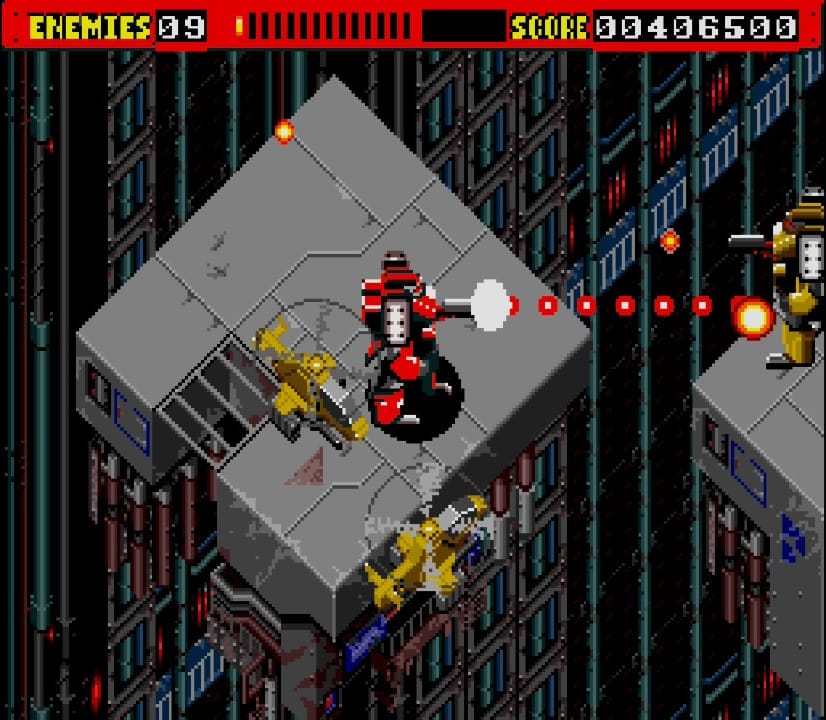
Your mech loses function and turns red as you take damage.
It’s your managing of those weapons and your health that makes Final Zone feel truly like a Wolf Team game. I mean, besides that aiming always feels a little off since you can’t change the direction you shoot in while firing and are locked into strafing at that point, and the ability to dash in a mech is more of a hindrance than a benefit given how out-of-control fast you move and that you are constantly able to get stuck on the game’s geometry even while walking — the almost, but not quite hallmark of early Wolf Team is on full display here, it’s true. But the added layer of complication that managing your weapons brings is what makes Final Zone feel in line with the rest of the series in terms of pushing some boundaries that didn’t need to be pushed, only here the system works. It can be tedious, sure, in the sense that if you want to constantly tinker to ensure maximum likelihood of always having the best weapons protected then you’ll be pausing a game that takes like 30 minutes to play otherwise endlessly to do so, but you can also go about it in a more relaxed way and still thrive.
That’s a lot of preamble, so here’s how the system works: there are 20 different weapons in Final Zone, but you can only use two at a time, and carry 14. Like with Final Zone II, there is a primary and a secondary weapon, and the setup is the same with the first being weaker but infinitely available, and the second is an available weapon in a limited but stronger (and slower) form. You can choose to equip whichever available one you want at any time, to either hand, but different weapons are going to be more effective in different situations, and something like the Rope Gun is incredible against bosses and should be saved just for that, since it attaches to them, so don’t go wasting that against random foes.
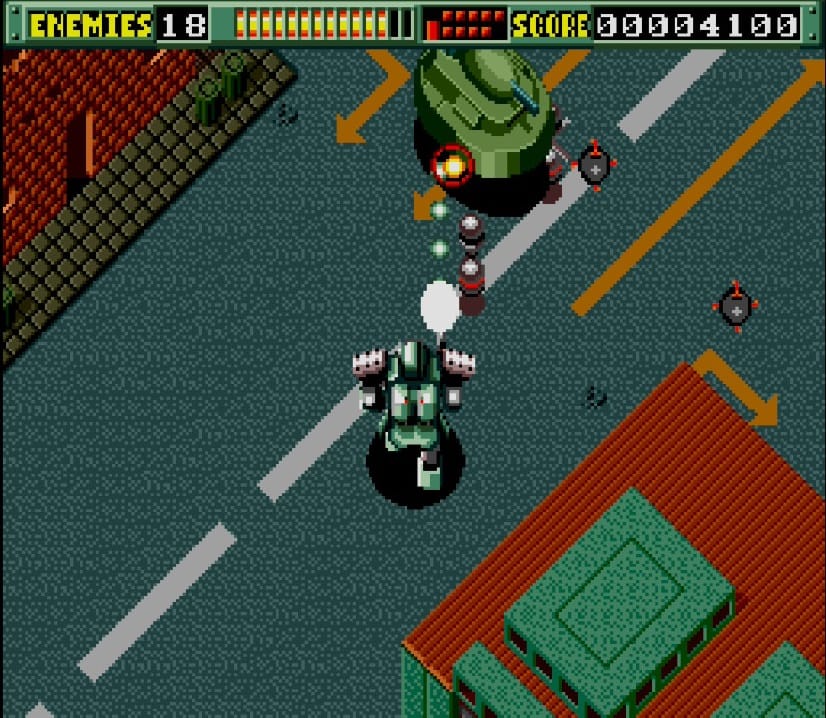
Basic enemies like tanks are easy enough to defeat: just don’t stand in their path.
Something like the Grenade gun is a burst shot in its primary mode, but in the alternative fire shots a circle of bullets out of your mech simultaneously — that secondary option is actually fairly weak, since enemies take more than a shot or two to die, and you aren’t going to hit with most of those unless you’re surrounded. And even then, you’re not doing killing damage with a single shot. Other weapons, like the Spread, will fire just one missile at a time, rapid-fire, with a short range in its primary form, but in its alternate shoots off three homing missiles at once — you can see the differences in utility there, especially once you get a sense of how different stages are designed or how certain bosses move. Some of them are in place, like the first in which you chase a military train loaded with guns and destroy it car by car from behind, while others might involve some other high-powered mechs — and multiple of them — surrounding you at (controlled) dashing speed while attempting to corner you somewhere where they can mine you to death. Homing missiles or the Rope are unnecessary for the former, but for the latter, you’ll save yourself a ton of health and time.
From the pause menu, you can equip different weapons on different parts of your mech, but the only ones that truly matter are the two up top — the ones you are actually firing — and the very bottom one. That’s because your mech, as it takes damage, loses access to whatever weapon has been put at the bottom, aka given the lowest priority. The only way to get access back is to heal — those drones that deliver health and ammo are useful, yes, but they give back just a single tick of health upon collection, so it’s not a quick process. Final Zone also lacks invincibility frames, meaning, you don’t get a brief second to get out of the way before taking damage a second time. Your health can be melted right off of you in a hurry if you get hit by a barrage of mines or lasers or missiles, so “don’t get hit at all” is your best possible plan. And when you can’t avoid that, at least make sure your strongest weapons aren’t equipped to the more susceptible parts of your mech. From the outset, even on easy, you won’t have access to everything, as you begin the game at half health and go from there, and the only way to recover a more significant chunk of health than from a drone is to die and continue. Which, you know. Not ideal, especially not with limited continues.
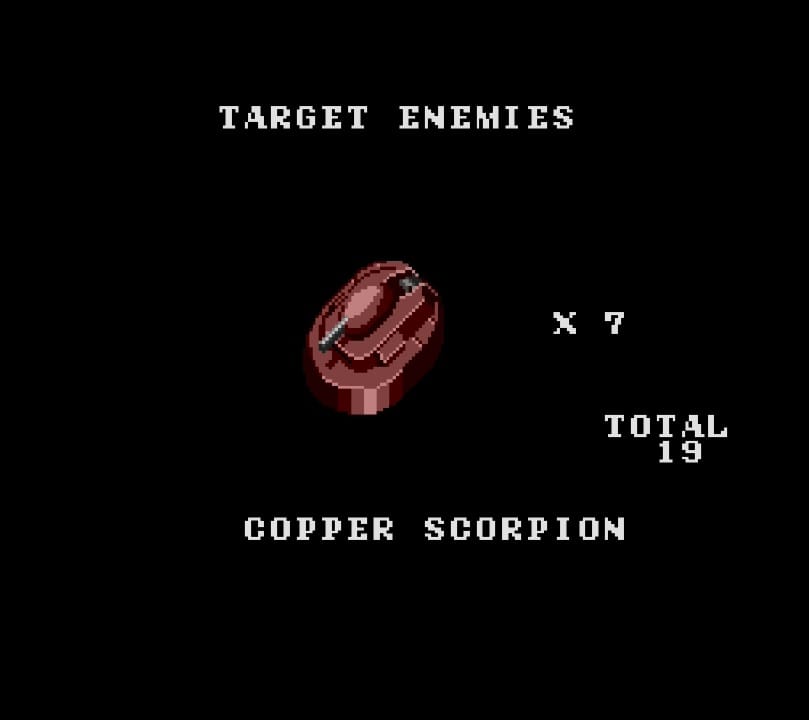
Before each stage, you get a breakdown of the total number of enemies and how many types of each you must eliminate in order to proceed.
Realistically, you can beat this game without constantly tweaking that list, but it’s probably good to eventually identify a few favorites and put them in protected places, or to turn a weapon you know you’ll get a ton of use of as a secondary weapon into a primary one with unlimited ammo to hang on to it even at the times your health is at its lowest. On the toughest difficulty, you will have to be more mindful of what weapons are being prioritized, given your lack of second chances and the intensity of enemy strength. If you’re playing on hard, though, you’ve already gotten quite a bit out of Final Zone, though, and are unlikely to have a real issue with regularly interrupting the action for a bit of housekeeping.
Final Zone isn’t perfect, by any means. That dash is genuinely more of a pain than it is a help, especially as the level design gets less open and the stages smaller to give you fewer places to run and to increase the chances of being surrounded and damaged. Shooting never quite feels good, either, since the strafing while firing in a completely straight line approach locks you into a pretty unnatural setup, all compounded by the isometric nature of things — it probably would have felt different if it had been a straight-up top-down affair, for instance, but the isometric angle does look pretty cool, that’s a given. And if you don’t want to futz around with a mech’s inventory and just want to be constantly fighting, well, you aren’t going to love this game on tougher difficulties. That said, like a lot of the best Wolf Team outings, there is something here that’s enjoyable despite the elements conspiring to make you not feel that way; don’t give up on it right away, and the difficulty will start to feel like much less of a barrier as its quirks and systems begin to make sense.
Also, the soundtrack rips — Motoi Sakuraba, folks. He’s had the juice for a long time.
Final Zone released for the Genesis and Mega Drive in 1990, and appeared on the X68000 as well, but then never resurfaced again for decades. Not a huge surprise, considering it was a solid game and not a huge hit or anything, and Wolf Team self-published it in Japan. In 2025, however, Ratalaika Games gave it a worldwide, multiplatform release for Playstations 4 and 5, the various Xboxes, Windows, and Nintendo Switch, and added the usual quality-of-life emulation elements it does for its releases, like limited rewind and fast-forward capabilities, some display options, difficulty manipulation beyond the in-game ones, save states, and the like.
It certainly makes for a Final Zone you can be more patient with by easing in, maybe using rewind in the moments you get caught on some weird level geometry or accidentally double-tap the D-Pad and use your dash to run headlong into a bunch of bullets before you can stop flying across the level, or learn from your mistakes with rather than relying on the limited continues. Final Zone is a game where knowing and understanding the systems pays off and makes it a more rewarding play, after all, so being able to sort all of that out at whatever pace you prefer can help.
This newsletter is free for anyone to read, but if you’d like to support my ability to continue writing, you can become a Patreon supporter, or donate to my Ko-fi to fund future game coverage at Retro XP.
Reply