- Retro XP
- Posts
- It's new to me: Road Runner
It's new to me: Road Runner
Videogamus Arcadeus Excellentus

Marc Normandin
April 27, 2026
This column is “It’s new to me,” in which I’ll play a game I’ve never played before — of which there are still many despite my habits — and then write up my thoughts on the title, hopefully while doing existing fans justice. Previous entries in this series can be found through this link.
The early history of Looney Tunes video games belongs to Atari, which checks out the second you remember who it was that owned the giant 50 years ago. Atari founder Nolan Bushnell, in the lead up to coming out with the Atari VCS — later known as the Atari 2600 — sold the company to what was then known as Warner Communications in 1976. Licensing deals were a lot simpler when you were essentially licensing to yourself, so, a Road Runner pinball machine arrived in 1979, and then there was nearly a Bugs Bunny game for the Atari 2600 until it was canceled in favor of Snoopy and the Red Baron, marking the occasion of the first-ever Peanuts video game instead.
Looney Tunes would need to wait until April, 1984 for its first video game, when Taz came out for the 2600, as well — while you control the titular Tasmanian Devil, it’s always in the shape of a tornado with him spinning around. So, he only sort of appeared on screen in the game itself, and in Europe the game was instead released as Asterix — which, frankly, got a much more appealing title screen rendition of the licensed main character, as well. The Taz one looks like someone was drawing him from memory, but to be fair it was likely difficult to replicate his whole deal in the specific style and hardware of the time.
The next year, Atari Games, Inc., which spun out of Atari after the video game crash when Warner sold off a significant number of assets to Jack Tramiel, would release Road Runner to arcades. As Warner still had a 20 percent stake in the assets it had sold off, there was a vested interest in getting these characters adapted to video games, and while Road Runner wasn’t the first Looney Tunes video game around, it certainly looked and felt like the first to be a true translation of what those cartoons were about.
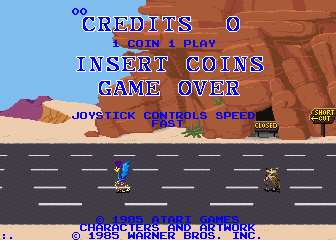
Image credit: MobyGames
Road Runner was released for the Atari System 1 board, which would also host the likes of Indiana Jones and the Temple of Doom, RoadBlasters, and Marble Madness. Bright colors, speed, loads of objects and detail… System 1 hardware was capable of producing some technologically impressive beauties, and Road Runner certainly qualifies. The sprites weren’t particularly huge here, but you can even see on the title screen that the backgrounds and landscapes evoke the coloring of the Road Runner and Wile E. Coyote shorts, and the two characters pop off the screen with instantly recognizable looks.
Road Runner is not an endless runner, no — this was 1985, we weren’t at that point in the development of these genres yet — but it’s certainly a predecessor. It’s not quite right to call the game as a whole a platformer, as there are only certain sections where Road Runner has to leave his feet, using the only button the game has to do so. It’s not a racing game, either, even if you see it labeled as such on occasion, but instead a chasing game — you control Road Runner, in an attempt to keep out of reach of old “carnivorous vulgarius” himself, Wile E. Coyote. And to do so, you have to, essentially, endlessly run. That’s a bit of an oversimplification that does the actual high-level skill and strategy of the game a disservice, though, and you can stop, so you won’t see the runner label applied, either. It’s a chase game; you are being chased.
The version of Road Runner that was released was not always the plan, and in fact the game predated the creation of Atari Games. In 1983, Atari was working on a prototype LaserDisc game which was, in many ways, what ended up being released on System 1 hardware as Road Runner. There are a couple of notable differences, however: the game’s backgrounds and roads in the prototype were all stored on the optical storage of the LaserDisc rather than generated by the PCB — that’s printed circuit board — as ended up being the case for the actual release of the game, and the LD edition was loaded with cutscenes from actual Road Runner and Wile E. Coyote shorts. Basically, when Wile E. Coyote died in the game, it would cut to actual footage from one of the shorts to show him dying in a similar fashion.
It’s difficult to tell in this video how high the quality of the roads and backgrounds were, but if you’re familiar with what the actual shorts starring these characters looked like, you will recognize a little more of the look that layout artist and background painter Maurice Noble utilized after taking over these shorts, where the southwestern American desert was made more visually abstract — all kinds of rock formations that don’t make logical sense and don’t exist in nature, but don’t have to since this is a cartoon. Meanwhile, the System 1 game leans more Robert Gribboek, likely since what was possible graphically changed with the move from LaserDisc; he was going for realism in the visual representation of the desert before Noble’s era. But, aggravating shadows and 2010 shaky cam aside, this is what we have to work with when it comes to footage of a rare prototype in action.
During development, Atari decided that LaserDisc wasn’t the future nor the present, and Road Runner became a conversion kit release for System 1 hardware instead, with all of the LaserDisc elements removed. While the cutscenes were a nifty addition that made everything feel a little more genuine, and the background graphics and roads look wonderful even in a video that objectively does not, there is something to be said about how the Road Runner release that did happen is paced. You aren’t interrupted by these cutscenes in a game where the idea is to run, run, run, to keep ahead of Wile E. Coyote, to always be moving to avoid him. You get to stay locked in, in your flow state, however you want to describe it when you’re really feeling the game. There’s something to that idea, but maybe it’s easy for me to say that in 2026 when I have multiple Looney Tunes shorts collections I can pop in to a media player when I want to experience a little Coyote vs. Road Runner action.
Speaking of the shorts themselves, Chuck Jones, director, producer, and one of the creators of the Road Runner and Wile E. Coyote shorts alongside writer Michael Maltese, revealed that he had rules for how these cartoons were supposed to go, which were published in his (highly enjoyable) 1990 memoir, Chuck Amuck: The Life and Times of an Animated Cartoonist. Those nine rules:
The Road Runner cannot harm the Coyote except by going “Beep-Beep!”
No outside force can harm the Coyote — only his own ineptitude or the failure of the Acme products.
The Coyote could stop anytime — if he were not a fanatic. (Repeat: “A fanatic is one who redoubles his effort when he has forgotten his aim.” — George Santayana).
No dialogue ever, except “Beep-Beep!”
The Road Runner must stay on the road — otherwise, logically, he would not be called a Road Runner.
All action must be confined to the natural environment of the two characters — the southwest American desert.
All materials, tools, weapons, or mechanical conveniences, must be obtained from the Acme Corporation.
Whenever possible, make gravity the Coyote's greatest enemy.
The Coyote is always more humiliated than harmed by his failures.
Now, Maltese felt these were “post-production observation” and not rules used during the making of these cartoons, as he explained in an interview included in another book, Hollywood Cartoons: American Animation in Its Golden Age, but that part isn’t necessarily important for the point that’s about to be made here. What matters, as far as adapting Wile E. Coyote and Road Runner’s escapades into other mediums, is whether or not those adaptations manage to feel true to the originals — whether these were actual rules or just “post-production observations” brings you to the same place, as far as that feel goes. Road Runner, the video game, does an excellent job of adhering to these nine ideas, which helps it feel very much like it’s honoring the source material and not just slapping a license on a game. No offense to The Bugs Bunny Crazy Castle, which is fun in spite of its failures in this arena.
Wile E. Coyote is repeatedly entrusting his cause to Acme products, like rocket skates, dynamite, literal rockets, powered pogo sticks, and more — the end result for all of these, should Road Runner escape his clutches, is for some kind of explosion or fire that temporarily stuns Wile E. Coyote in place, looking humiliated but able to literally and figuratively dust himself off and get right back to it. Road Runner doesn’t ever harm his antagonistic partner himself, but his actions can lead to the Coyote being harmed: for example, thanks to Wile E. Coyote tracking Road Runner as closely as he does in terms of the paths he takes, you can basically trick him into getting hit by a car by dodging it at the last second.
Technically, it’s the Coyote’s own ineptitude that caused the accident, since he couldn’t dodge the vehicle the same way that the Road Runner could, and there was no direct intervention by the fleeing bird, either. Plus, since the cars are a part of the natural environment of the southwestern desert — you are on a road, after all — they are not an “outside force,” nor are they a circumvention of the rule about every “mechanical convenience” coming from anywhere but the Acme corporation. Also, in the very first short with these two, Wile E. Coyote gets run over by a bus whose horn he mistakes for the Road Runner’s signature “Beep-Beep;” see? Ineptitude and vehicular mishaps were established as a risk from the start.
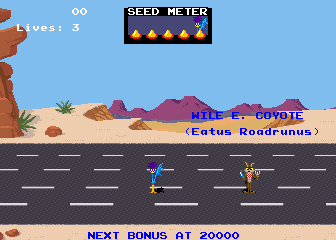
The footage from shorts found in the LaserDisc prototype is gone from the game System 1 intro, but the fake Latin gag still found a home. Image credit: MobyGames
Wile E. Coyote is hoisted by his own petard on plenty of occasions, especially in later levels, as mines left laying around the road end up being just as much, if not more, of a hindrance to him than they are for the eagle-eyed Road Runner. (Road runner-eyed Road Runner?) They are regularly placed near piles of bird seed, which have also been left out to slow the Road Runner and control his path. Little does the Coyote know, though, but in the game, the bird seed also increases Road Runner’s speed — you can get a lot more done on a full stomach. And picking up all the bird seed will result in higher score bonuses at the end of each level, as well as giving you more in-level points for keeping a combo going throughout. Later on, lemonades are also introduced: the idea here is that they take longer to acquire than the bird seed, so there’s more of a chance that Wile E. Coyote will be able to sneak up from behind and grab the Road Runner while thirst is being quenched. They are optional pickups, but also worth a ton of points, so worth sipping whenever you’ve got a moment to spare.
And it’s worth it to let the Coyote get close, but not too close: it’s not said openly by the game that this is a going concern, but you’ll notice at some point that when Wile E. Coyote falls behind and off the screen, he’ll don a pair of rocket skates and come back faster than before. Those rocket skates don’t last forever, but he only has to catch up to Road Runner once for you to lose a life.

Road Runner received ports to a number of platforms, including the 8-bit Atari ST home computer. Image credit: MobyGames
Dodge vehicles, avoid mines, jump over gaps to avoid falling, time your forward — and sometimes backward — progress to avoid Wile E. Coyote’s incessant grasping. This game is a bit nonstop, although it does control at variable speeds thanks to the joystick used to control Road Runner’s momentum: you can speed up or slow down as necessary, though, stopping is not advised. If you didn’t watch that above video of the arcade game being played, you should, because you’ll see someone who has mastered it in action — Wile E. Coyote never stood a chance.
Road Runner ended up being ported to various platforms in the aftermath of its arcade release: the Atari 2600 as well as an unlicensed Tengen cartridge for the NES, and then a slew of home computer ports for the Atari ST, Amstrad CPC, Commodore 64, MS-DOS, and ZX Spectrum. None of them can match the System 1 visuals, but the Atari ST edition at least makes a pretty solid effort since it was a 16-bit machine. The NES game also looks good, though not at the level of the Atari ST release thanks to the more limited color palette that Nintendo’s 8-bit console was working with. Still, there’s a level of detail there that can be appreciated considering those circumstances, especially when put up against most of the other 8-bit releases.
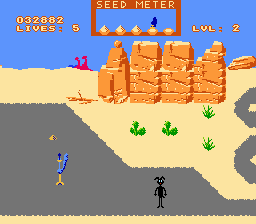
The NES version of Road Runner is missing some of the brighter colors and detail of the original arcade edition and Atari ST port, but is one of the more impressive 8-bit renditions despite this.. Image credit: MobyGames
Like so many classic Atari arcade titles and games that Warner owns the rights to, Road Runner is nowhere to be found in 2026. At least, not on modern hardware in a legal fashion. Emulation exists, though, and if you happen to find an actual cabinet to play Road Runner, you should — that joystick gives you some serious freedom of precise movement for the little guy, and can help you more easily escape the clutches of the always-hungry Wile E. Coyote. I’ve filed this one under “It’s New To Me,” but Road Runner was actually new to me in spring 2025, when I played the cabinet at the American Classic Arcade Museum at Funspot in Laconia, NH — an unlicensed Tengen cartridge and another trip to the ACAM later, and it’s not so new to me anymore, but I picked up that port and played it again on a cabinet for a reason. This is a real good one, and worth playing and playing again to commit its patterns to muscle memory like the best arcade games so often are.
This newsletter is free for anyone to read, but if you’d like to support my ability to continue writing, you can become a Patreon supporter, or donate to my Ko-fi to fund future game coverage at Retro XP.
Reply