- Retro XP
- Posts
- Past meets present: Carbuncle Pi
Past meets present: Carbuncle Pi
D4's ProjectEgg is adding Compile's Disc Station games to its library, so now you can solve platforming puzzles with Carbuncle.

Marc Normandin
January 28, 2026
This column is “Past meets present,” the aim of which is to look back at game franchises and games that are in the news and topical again thanks to a sequel, a remaster, a re-release, and so on. Previous entries in this series can be found through this link.
This one will take a little unpacking, for those who aren’t familiar with Compile’s whole deal. Our idea of what an independent game developer is these days is sometimes tough to pin down, but Compile was certainly a prototype way back in the 1980s and 90s. The Japanese studio released tons of games for consoles and handhelds and Japanese PCs, but they weren’t all major releases or handled by big publishers by any means. Compile regularly self-published, but did so most regularly with smaller, niche releases for Japanese computers like the MSX2 and NEC’s PC series.
These games, in many cases, were released as part of Compile’s subscription disk magazine, Disc Station. This is where the dungeon crawler Madou Monogatari first released — as part of Disc Station Special: Christmas Edition in 1989 — which in turn means Disc Station is also the origin of worldwide puzzle sensation Puyo Puyo, even if indirectly. Compile used the bi-monthly (and later monthly) Disc Station to release some games the studio was messing around with and experimenting with, a la Madou Monogatari, or sometimes just to put out something that was probably going to be difficult to find a publisher for given its short length or oddness or lack of commercial appeal — for instance, it seemed like Compile stopped making shooting games, or STG, after large swaths of the developers left to form other studios like Raizing, but new shooters like 1996’s PC-9801 release Rude Breaker were just coming out in Disc Station instead of to retail.
Sometimes Compile would iterate on an existing concept of theirs, or introduce a new one, via Disc Station. One such example is the Disc Station’s 1990 action-puzzle game Nyanpi, where you play as a cat walking around stages to try to reach balloons to pop, and once you manage to pop them all you make your way to the trash can that signifies the level is complete. Nyanpi originally had 40 levels, but there have also been expanded ProjectEgg releases of Nyanpi over the last 21 years for the MSX2 and Windows that included all the additional stages that were created over the ensuing years and Disc Stations, titled Nyanpi Collection. This could be important for later on, so remember that bit.
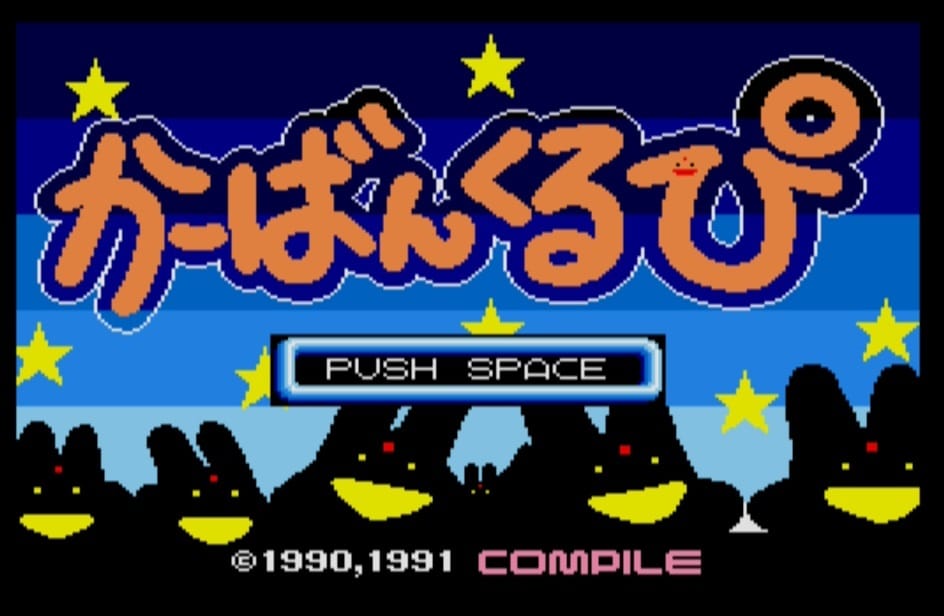
Carbuncles, plural.
Compile also liked to make games featuring its mascot, Carbuncle, whether they were entirely new or reskins that revisited an existing game. MSX2 game Carbuncle Pi is the latter: it’s Nyanpi gameplay featuring Carbuncle instead of a cat, and the trash can has been replaced with his buddy Arle from Madou Monogatari and Puyo Puyo, as well (lol). In this Disc Station release from 1991 (issue #24), the balloons are now red gems, and some of the cat-centric level design is now built around Carbuncle or random terms you might associate with Compile games, like the one that spells out “BLASTER BURN” — another Disc Station release by Compile — with its platforms. Oh, and when you collect every gem in a stage, you hear Compile’s little extend jingle from the Aleste games playing, which is a treat and not just because here you experience that without having to dodge a ton of bullets to do so.
The gameplay is simple enough to explain, but it does ramp up in difficulty — it’s the kind of puzzle game where, if you can’t see at least an inkling of the solution in advance or can’t put together a plan through trial and error, you’re going to struggle. You walk around as Carbuncle, and you have three moves. You can jump — but only straight up, not side to side — you can fall, and you can push, so long as the path for what you’re pushing isn’t obstructed. You need to take into consideration the gems for more than just collecting them, as you might need to use them as platforms in order to reach other gems you otherwise won’t be able to get, or to get to another platform you have to manipulate in order to make that part of the stage accessible after you do pick up the gem.
The very first level (as well as the brief tutorial) puts you in a situation where you can’t collect all of the gems if you grab them in the wrong order, so it’s not like the game hides this from you. The whole game concept is built out of this kind of sorting out the order of operations, and later stages don’t necessarily have more gems to collect, but instead have harder-to-reach ones or additional complexity for how you’re even going to get to the one or two gems that are even present.
Mastering the jumping is going to be vital, because if you walk too far too quickly into a gem, you’re going to accidentally collect it. And if you needed it to climb elsewhere, well, you’ll just have to restart the level. Luckily, there are no lives or continues, and you can retry as many times as you need in order to get things right, but you can also cut down on the mistakes by holding down the proper button in order to keep Carbuncle rooted in place. This lets you better guide the when of your movement and jumps, which again, are straight up but allow you to reach a platform so long as it’s right there to your very direct left or right. Falling works similarly, in that you can only fall straight down, not at an angle, which makes the placement of platforms — whether inherent to the level or from your manipulation of them — vital to actually getting around even when you aren’t jumping.
A visual example might help.
This is round 19, the second-to-last stage of Carbuncle Pi, a little more than halfway into it after quite a bit of trial and error for positioning and a handful of gems already collected. You could just grab some gems from the start or close to it — you begin the stage at the bottom platform near the two to the left — but if you do so, you won’t be able to reach the far-left gem on the second row of platforms, since the far-left gem on the very bottom doubles as a platform. So, you have to work your way up through the maze of movable platforms, using each part of them at different points to progress, and then work your way back down once you’re at the right spot with the gems, before climbing back up to meet Arle and conclude the round.
Each stage deals with this kind of thing, where you have to figure out which gems are platforms and which ones are safe to collect, which way the movable platforms have to be pointing at any given moment in order to allow you to make your way through the stage, how to even reach some of those platforms to begin with, where to start, what to move now so that it impacts you later on — in stage 20, for example, if you shift the platforms on the right the wrong way to start, you’re going to be so mad at yourself about 90 seconds later when you get to the part where you needed them to be pointed a different way in order to collect the one gem that is otherwise inaccessible. Again: at least you get to reset as many times as you want!
To circle back to ProjectEgg for a moment, it’s D4 Enterprises online subscription service for playing old Japanese video games, especially old computer games released for platforms like the MSX or NEC’s PC series of computers, which they are able to do thanks to collecting the publishing and distribution and licensing rights of a whole bunch of these companies over the year. D4 owns the rights to most of the Compile library, and recently started dipping into the Disc Station vault in its console service for Nintendo Switch and Switch 2, EggConsole. On Christmas Day in 2025, D4 released Carbuncle Pi to the EggConsole series; whether this is a way to get some version of Nyanpi gameplay out there or an introduction to it for a future release of the much larger Nyanpi Collection down the line is unknown, but either way: hey, Carbuncle Pi!
One benefit to the EggConsole edition of Carbuncle Pi is that you can use the save state or rewind functions if the idea of starting a stage over from scratch every time you mess up is just too much to handle. But it’s worth noting that the stages themselves are short, and that you can complete this entire game in one sitting if you have the patience for it as there are just the 20 levels. Of increasing, ramped-up difficulty that require you’re able to visualize a solution in advance or at least figure out where to properly start in order to get there, sure, but still just 20 total.
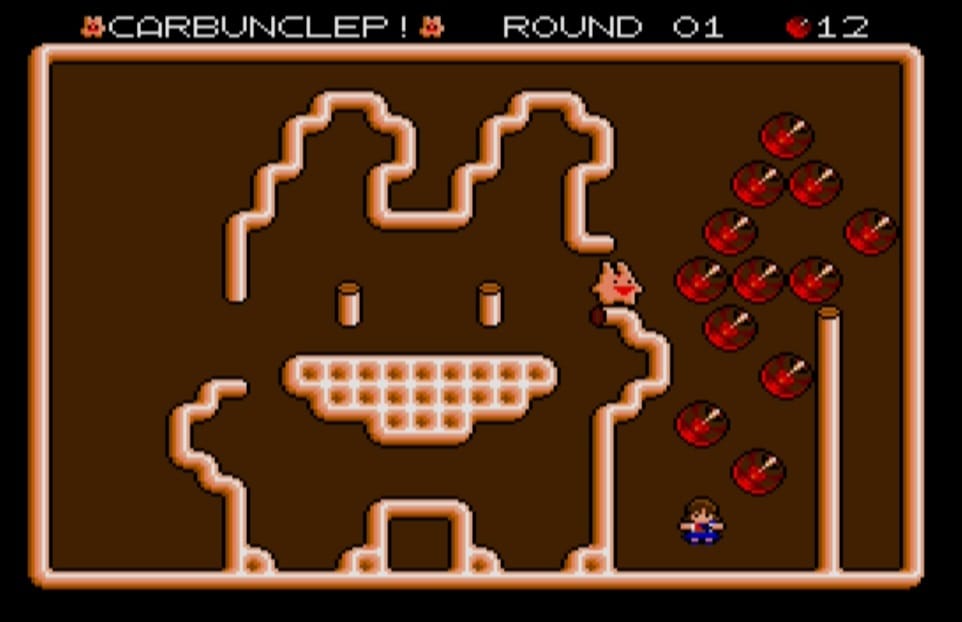
Right from the start, you’re hit with Carbuncle-themed design, as well as gems that have to be collected in a specific order lest you fail.
Carbuncle Pi is by no means the best or most robust experience that Compile ever put in Disc Station, but it’s a fun continuation of an existing idea that the vast majority of its current possible audience has no idea even exists. The translation from MSX2 controls to a gamepad went smoothly here, too, which is no surprise given how few inputs are necessary to play — you move Carbuncle and you jump, sometimes holding down a different button to keep him from moving first, and another button resets the stage, that’s the whole of it — and it’s not a game that required a translation in order to understand what’s happening. Any words that are here outside of the title screen logo are in English, anyway, and those just tell you what round you’re playing in and how many gems are left, anyway, the latter of which you could just see on-screen by counting yourself if that weren’t the case.
You should check this game out if you’re into puzzle games or obscurities at all — EggConsole games being priced at $6.49 helps compel that kind of experimentation — but I am curious about whether or not this is a preamble to an eventual Nyanpi Collection release, or if this is the way that D4 and EggConsole are going to handle the existence of this particular style of Compile puzzle in the west, or a way to capitalize on a known mascot among the kinds of sickos who are looking into EggConsole releases in the first place. The gameplay is identical, but there is so much more Nyanpi than there is Carbuncle Pi, and Carbuncle Pi was a lovely little weekend diversion, so here’s hoping that this is just the start of a whole lot more Compile action-puzzle in our lives.
This newsletter is free for anyone to read, but if you’d like to support my ability to continue writing, you can become a Patreon supporter, or donate to my Ko-fi to fund future game coverage at Retro XP.
Reply