- Retro XP
- Posts
- Past meets present: Scurge: Hive
Past meets present: Scurge: Hive
The answer to the question, "What if a Metroid were isometric?"

Marc Normandin
January 02, 2026
This column is “Past meets present,” the aim of which is to look back at game franchises and games that are in the news and topical again thanks to a sequel, a remaster, a re-release, and so on. Previous entries in this series can be found through this link.
Scurge: Hive isn’t exactly like Metroid. It’s very much its own thing with its own ideas. However, it also very clearly pulled inspiration from Nintendo’s long-running series, and not in the usual Metroidvania ways. Well, also in some of those, but specifically here I mean things like “a bounty hunter receives a distress signal from a galactic military official while wearing a skin-tight specialized outfit” and “enemies are more easily defeated with specialty beams that you can cycle between at will” and “your ship AI is your source of direction and companionship and you have been infected with a virus that will kill you if appropriate measures aren’t taken, also it will destroy the universe if you let it escape the facility it’s wreaking havoc on.” That last bit is more Metroid Fusion than anything, sure, but that game predates Scurge, and if the reverse were true, because people are so normal about Nintendo, we would be 20 years deep into them saying that Fusion’s whole deal had been lifted from Scurge.
None of this is a negative, of course (besides said lack of normalcy), but just to let you know how Orbital Media’s game wears its inspirations in very visible places. The gameplay is also very Metroid, with you continually finding upgrades that unlock new areas for you while blasting away a million respawning enemies and being judged for how long it’s taking you to complete it all. And the -vania part of things gets representation, too, with protagonist Jenosa gaining levels to increase her health and the strength of her attacks courtesy of said continual blasting.
There are a couple of things that make Scurge stand out as its own thing worth zeroing in on here, and they are also what make this a more appealing experience than a Metroid-like to tide you over in between releases of the real thing, in an era before “Metroidvania” was a search term on Steam that would bring you roughly two billion results. Hell, at that point, “Metroidvania” wasn’t even a fully ubiquitous name for the genre yet. The first of these is that Scurge: Hive takes place from an isometric perspective, rather than as a sidescroller. It changes the way platforming works, for one, but also combat — you can be surrounded, and you will be, if you don’t handle the kind of mobs that just didn’t exist in the genre’s standard presentation because of the way existing in that space even worked.
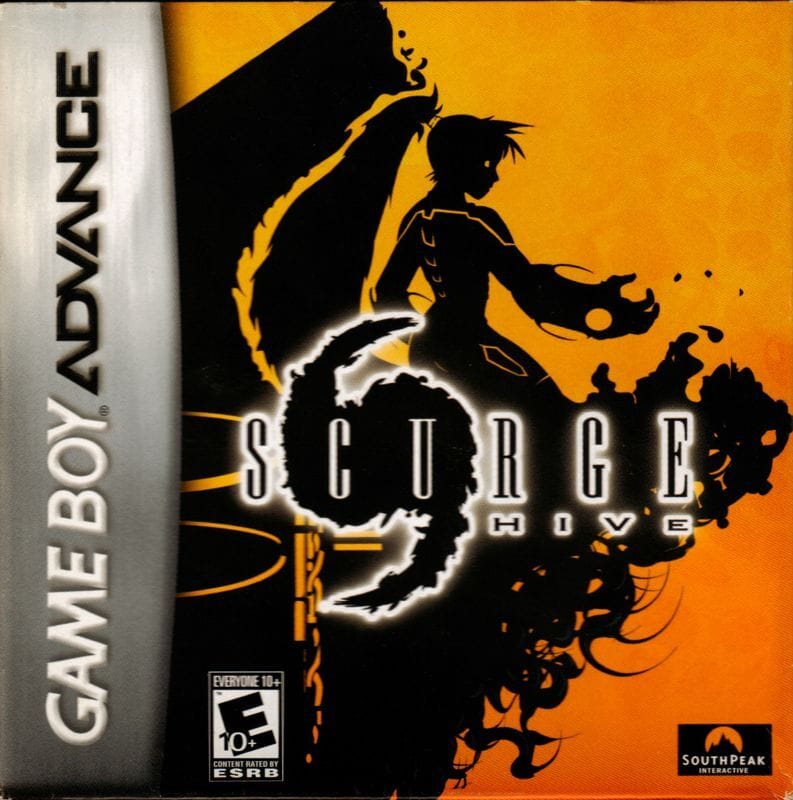
Image credit: MobyGames
The most significant difference, though, and the thing that will drive how you play Scurge and interact with every single facet of it, is the aforementioned infection. This isn’t just a narrative device that is saying oh, you have X amount of time before the virus kills you, that then plays out via cutscenes at predetermined points. No, your character is infected in a way that impacts gameplay: the rate of infection spreading through your body is constantly displayed at the top of the screen, and it is always climbing. You have a way of bringing it back down, as the game’s save points scattered throughout each area are known as Decontamination Platforms and are used to reset your infection level, but never to remove it entirely. When you step off of the save point, your infection has already climbed back to two or three percent. Your suit is specially designed to keep the infection from immediately taking over your body and turning you into a titular Scurge, but it is merely a filter that impedes its progress, not a way to fully counteract it.
When your infection level reaches 60 percent, you start to hear Jenosa’s heart beating. At 80 percent, that heartbeat is a little louder and a little faster. At 90 percent, it sounds like it’s trying to burst out of her chest, and at 100 percent it’s at its loudest, and also your health starts to drain, a process you cannot stop without reaching a save point to reset the infection. You have very little time in the grand scheme of things before your infection shoots up to worrying levels — just about enough to get from one save to another, or, if things are taking too long for you, for you to backtrack and then return to whatever room you were working on solving before the infection became too much of a risk to continue on. You get more time late in the game since your health is so much higher by then, but the rooms you’re solving are more complicated and difficult at that point, too, and the area maps more labyrinthine as well. Your infection level also spikes quicker if you step on the terrible red biological material scattered throughout the game, or from taking damage from enemies infected by the virus.
Even leaving aside the multi-stage final boss, this isn’t a game where you can just skip the combat and leveling to save time. That will catch up to you, especially when you’re in a position where letting some health tick off via infection is necessary in order for you to complete the trek to the next save point and infection removal. You have to balance this need to constantly be moving forward with the environmental puzzles you must solve and the combat you really, really should partake in, even if it slows you down. Defeated enemies are the only source of health recovery besides the save points, and collecting those health pickups from downed foes are also how you get your experience points. You begin the game with all of 25 hit points, but can go up to 999 at the maximum level. There are times where that much health will seem like overkill, and other times where you will be worried that it isn’t nearly enough. Wow, it really is like a Metroid game!
As for those environmental puzzles, they are regularly tied to platforming, pathfinding, and specific skills you pick up as you play. You get a tether pretty early, which serves as a grappling hook in addition to being used to latch on to objects and enemies to drag them around. You can only reach some areas with the double jump you’ll eventually acquire. Others are too dark to be explored until your suit can radiate light, or full of poison gas that will sap your health until you find a counter to it. There are switches that have to be powered with an electrical weapon, and others that need the charge taken from them. There are thick branches to be burned, and switches that require you place something heavy on top of them. Sometimes that “something heavy” is in the room already, and other times it’s a block you need to make out of an enemy using your cryostasis beam. There is an adrenaline upgrade that lets you move faster so that it appears as if time has slowed down, which is useful for moving past certain obstacles that block your progress if they hit you — and they will — at normal speed, or just for putting distance between you and some enemies you don’t feel like fighting. There is a plasma bomb that takes time before it explodes, but it has a little bit of a directionally-based homing element to it, and can also blow open blocked doors or boulders in your way, opening up previously closed off areas.
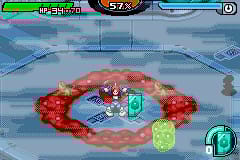
Image credit: MobyGames
The weapons, in particular, will require mastery, as how quickly you’re able to progress through an area or clear a room of foes will be determined by your ability to react contextually via weapon choices. The normal beam works against every kind of foe, but it’s weak and will take you the longest — you can get away with it at first, but as mobs grow in size and strength, you’ll end up avoiding it entirely. You get an EMP that quickly disables enemies powered by electricity in some way, such as the many, many security drones — it also sets off a chain reaction when one dies, which damages or outright kills any other foes in its vicinity. The Dissipator is for energy-based enemies, as it breaks them down on a cellular level. Combustion is basically a heat blast for burning biological enemies alive.
There is a rock-paper-scissors element to this trio to watch out for, too: Combustion, for instance, will either instantaneously defeat a biological enemy or cause it to take all of two shots to defeat them, or if it hits a mechanized foe it will power them up. The Dissipator eradicates energy-based enemies, but powers up biological foes. The EMP empowers energy-based enemies while wrecking the drones and robots. When you accidentally (or purposefully?) shoot the foes that are empowered by a particular weapon with that weapon, they move faster and hit harder, and you know you messed up because a big “Attack Up” message appears above them, and also they come after you in a hurry to use their newfound power on you. So, you spend all your time trying to not be infected to 100 percent and die from this mystery virus, while also continually pressing the R button to open up the radial menu with your different weapons and switch between them in order to combat the foe in front of you.
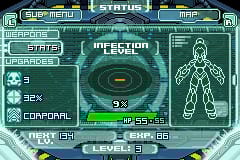
Image credit: MobyGames
And no, it is not as simple as “oh this area is full of mechanized enemies, time for the EMP.” It’s a mix. It’s always a mix. You’ll find yourself constantly, constantly switching, angling yourself to take out one type of foe before reangling and switching to get a different one, or calculating the risks of powering up one type of enemy while you dispose of the other, or going hey you know what, this mech in the middle of these energy guys will explode along with them if I can set off a chain reaction here.
The game is broken into a central hub area, and from there you go to other locations where you will use whatever new upgrade you have found — or find additional upgrades — in order to progress further through said central hub. You have to turn on all the teleporters that the staff, which you can barely find any remnants of besides memos and the occasional corpse, made sure to turn off. They did so to keep the virus, which very much seems to be a conscious entity growing in power and size and intelligence as it infects more and more oh that’s why the game is subtitled Hive, from leaving the facility and spreading throughout the galaxy. The problem is you can’t get to the source of the infection to get rid of it until you reopen all those teleporters, which require you to move around a bunch of power generators in environmental puzzles scattered throughout each area. You will become very efficient at this, but luckily whenever you go to the closed-off teleporter in each new area, the location of these security nodes will appear on your map, which also autopopulates with the location of Decontamination Platforms/save points.
Unfortunately, the location of the many, many security keycards you will need to open up locked doors do not show up on your map. Which is fine in terms of having to search them out, but once you did enter a room with one, it would have been nice if it then showed up on your map as including a card, since there are times where you can’t get to one just yet, or a room has multiple exits so you want to focus on a little more exploration or have to since again, you can’t always get to a card you can see when you see it. This is a minor complaint, however, and at least the game continually dings at you when you’re in a room with a keycard, so you can’t miss any of them by not noticing that you’re sharing a space with one of these required pickups.
The boss fights occur once you have unlocked a teleporter for use, as you are sent directly to it. These are all varied, but follow a similar pattern in that you have to figure out which weapon will be most effective against it, and then use it — sometimes that’s just for getting them to expose a weak point before you switch weapons and then attack with something else, sometimes you can just roll with a single beam from your gauntlet. The bosses are all huge and room-filling in one way or another, though, and are all a little gross in a way I am being complimentary of here. This is a game about a virus slowly corrupting everything it touches, including you, after all.
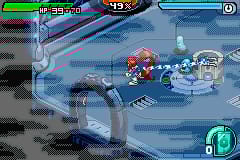
Image credit: MobyGames
While there is just the one game mode at the start, after completing Scurge, you unlock a hard mode as well as some alternate color schemes for Jenosa’s suit. Complete the hard mode and unlock a boss rush. Complete that, and you unlock the actual top difficulty — by this point you should already know where everything in the game is, or else you are just going to die.
The game’s soundtrack — which you should hit play on above — was composed by Jake Kaufman, who has worked on a number of projects you’ve heard of from those in the Shantae series, to Red Faction: Guerilla, to Shovel Knight, to one that a certain subset of you have definitely heard of in Cave’s Ketsui: Kizuna Jigoku Tachi. It’s excellent for setting mood in each area, and every boss has its own theme, which all slap. Really a tremendous soundtrack, and one that somehow wasn’t hampered by the Game Boy Advance’s admittedly inferior sound hardware that seems to lose all pleasantness the second the volume goes up.
The game as a whole was developed by Orbital Media, and published by SouthPeak Interactive for the GBA and Nintendo DS. With the exception of the DS version of the game, all of their titles were on the GBA. Racing Gears Advance was their first game, which came out in 2005 (2004 in Europe), and it was followed up by Juka and the Monophonic Menace, which released in PAL territories in 2005 and North America in 2006. Scurge: Hive was their final game, as plans for sequels to their other projects were canceled, and this despite receiving positive reviews for Racing Gears as well as Scurge. So it goes sometimes in the industry.
Given that they didn’t find enough success to continue on, it’s amazing how regularly secondhand copies of Scurge are seen whenever I go out to a retro games shop. It’s always there! It’s difficult to miss that yellow background on its cartridges, so it always stands out, but it seems no one who did buy it held on to it. And hey, even if it weren’t available for those with original hardware and a penchant for perusal, Scurge: Hive has found a second life on modern platforms. In 2025, it released on the Switch, Playstations 4 and 5, Xbox One and Series S|X, and PC. This time around, it was published by Ratalaika Games, and it has the same emulation and quality of life options as the many games they have re-released in the present. Their ports aren’t the best around for this sort of thing, but hey, you have save states and rewind and fast-forward and some options for tweaking the presentation. You have played far worse modern ports, too.
Scurge: Hive is one that’s absolutely worth your time if you’re into this kind of pathfinder game. That it is constantly pushing you forward out of necessity — you will die otherwise — combined with its rock-paper-scissors weapon system in an action game makes it stand out even as it elbows you and goes, “psst, hey, do you like Metroid Fusion?” There is much more to it than its plain-as-day inspirations, is the thing, and the final result is a bit of an oddball in all the best ways.
This newsletter is free for anyone to read, but if you’d like to support my ability to continue writing, you can become a Patreon supporter, or donate to my Ko-fi to fund future game coverage at Retro XP.
Reply