- Retro XP
- Posts
- Re-release this: Phoenix
Re-release this: Phoenix
A stepping stone for early shoot 'em ups in between Galaxian and Galaga, but with plenty to offer in its own right.

Marc Normandin
April 29, 2026
This column is “Re-release this,” which will focus on games that aren’t easily available, or even available at all, but should be once again. Previous entries in this series can be found through this link.
It’s rare that a game distributed by a company as significant as Taito has unclear origins, but that’s the case with the 1980 fixed shooter, Phoenix. Depending on where you look, development is either incorrectly attributed, cited as unknown, or assigned to one of two companies without a definitive response as to which it actually was. Sometimes you see Amstar, one of the companies with regional distribution rights, credited as Phoenix’s creator. Joel Hochberg, who worked for Centuri — the American distributor of Phoenix — said in a 2006 interview that “a small Japanese developer” was responsible for the game, and the licensing deal they had. A 2005 supplement to Masumi Akagi’s In The Beginning, There Was Pong, that collected development and publication data from games released between 1971 and 2005, cites two companies as possible developers: TPN and Hiraoka. You can’t necessarily take that at face value, however, as there have been errors discovered within this book, as noted on the Internet Archive page hosting the text.
TPN licensed the game to Taito in Japan, per Akagi’s research, while Hiraoka — also based in Japan like TPN — licensed Phoenix to Amstar, per Racing the Beam: The Atari Video Computer System. And per Akagi, Hiraoka and Amstar both then licensed the rights for American distribution out to Centuri. So, we know who didn’t develop the game — it wasn’t Taito, Amstar, or Centuri, and Atari entered the picture later for the home port — but all that does is narrow down who might have rather than definitively answer the question.
Which is wild, considering that Phoenix ended up being Centuri’s most significant arcade success: in 1980, the company posted losses of $4.5 million, per a report in The Miami News, but in 1981, the year Phoenix released in American arcades, Centuri made a $7.5 million profit, and it became their best-selling cabinet by 1982 according to The Jackson Sun. It was also one of the first three games that Atari contracted home port rights to, at a time when licensed home ports were still a relatively new thing and lawsuits for clones were becoming more frequent. And Taito was already Taito at this point: Space Invaders had released two years prior, in 1978, so the company deciding to attach itself to another shoot ‘em up was notable all on its own.
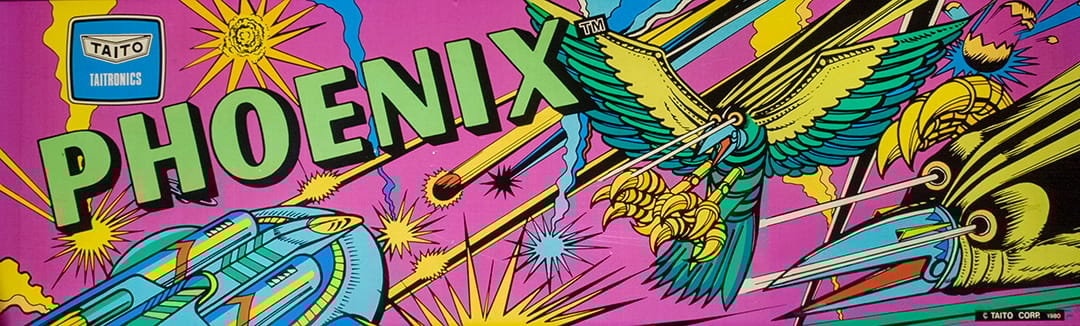
Image credit: Arcadeology
And yet, it’s an open question as to who is responsible for Phoenix despite all of this. It’s a shame, too, as Phoenix is… well, it’s not a missing link between Galaxian and Galaga, but it is a stepping stone between the two, a high-quality game that did well and was known in its era, which bridged the innovation gap between the two far more famous games a little and helps remind that hey, Namco didn’t just go from Galaxian right to Galaga. There were other companies, other developers, other ideas that existed and went out into the world in between. It’s fitting that Taito would be the one to distribute Phoenix in Japan, considering that they were responsible for Space Invaders, which in turn pushed Namco to develop Galaxian in direct reaction to it, in competition with a behemoth the likes of which the video game world had never known before and has rarely known since.
This is a lot of preamble, yes, but stick with it. Space Invaders created the concept of a fixed shooter, as well as the very idea of “what if enemies attacked the player,” a shift from the Breakout- and Pong-style games that dominated the era. Previously, video games with violence were more like Midway’s one-on-one dueling game, Gun Fight, rather than this kind of dynamic action setup. Galaxian, per designer Kazunori Sawano, was already in early development when Space Invaders landed, but after Taito’s industry-shifting hit took hold, Namco’s president Masaya Nakamura told the Sawano’s team that it had to be “the post-Invaders” game. While Galaxian wasn’t quite at the level Space Invaders was — truly, the list of games that have had that level of success is a short one — it managed to iterate on the concept in a way that made it popular and influential in its own right.
An early version of “rank” in shooting games, or STGs, came from 1979’s Galaxian, as Sawano explained that the ships were programmed to react to the player’s own movements and change their own in response, giving them “a will and personality of their own,” which would in turn cause the player to change their own behaviors, creating a constant back-and-forth loop between the two. (For more on rank’s history and purpose and implementation, here’s a long look at that and Battle Garegga.) Galaxian also featured RGB graphics (and is one of the first games to do so), displayed multi-colored sprites the year after Space Invaders arrived in black and white, and the hardware it ran on was capable of displaying scrolling, which in this case Namco used to have an animated, scrolling starfield in the background rather than changing from the fixed shooter format of the day. The look of the game was such a change for the era that Tomohiro Nishikada, the creator of Space Invaders, said of Galaxian in a 2000 interview that the follow-up games he was making with leftover black and white boards at Taito, in comparison, had “good gameplay” but were “a sad sight compared to the colorful screens of Galaxian.”
Game Machine had Galaxian behind only Space Invaders on the list of most successful arcade games of 1979 in Japan, and it managed to finish second in 1980 as well, behind another Namco monster in Pac-Man. Galaxian led to Galaga in 1981, which ended up being a massive hit even in comparison to Galaxian, to the point that it’s easy to forget, in retrospect, that Galaga was a sequel and that it’s part of the Galaxian series, rather than entirely its own thing.
Before Galaga, though, there was Phoenix, and Phoenix had further tweaks to the fixed shooter formula. Released in 1980, Phoenix also used a scrolling starfield background for multiple stages, but rather than twinkling white stars on a black background, instead, it featured planets, star fields, galaxies, just a wide variety of celestial objects, and all with a blue hue to them rather than white. The ship itself animated, as parts of it would be in motion as you moved the whole left and right. Enemy sprites were significantly larger, too, and every fifth stage featured a distinct boss that took up most of the screen’s real estate — bosses were still a relatively new feature to arcade games, as Ken Horowitz wrote in 2020’s Beyond Donkey Kong, and distinct bosses with their own stage even more so.
Whereas Space Invaders had every enemy slowly descend, the game only speeding up as more and more were defeated, and Galaxian purposefully slow-played the difficulty by having just one enemy ship come down at a time at first and gradually increasing the intensity of the entire experience as you cleared more and more levels, Phoenix had the enemy come down in bunches, to be fended off simultaneously, with little regard for whether you were prepared to take on a handful of foes at once… right in the very first stage. This level of challenge was even noted by Centuri in its manual for the cabinet, which stated that, “PHOENIX is an exciting new space game, with special audio and visual effects, challenging the skills of the most experienced player. Fascinating visual graphics and extraterrestrial sounds add to the intensity of this game.” Contrast this to Galaxian, which Sawano “spent a great deal of effort” to keep balanced and inviting, per that earlier interview. “The difficulty from one stage to the next is almost imperceptible; however, if you compare stage 1 to stage 10, it’s very clear that stage 10 is harder. That’s the kind of slow build-up I went for, where things gradually seem to get harder, but there’s no apparent disjunction. I think it’s a very important concept in game design.” Phoenix isn’t unfair by any means, but it clearly had a very different goal than Galaxian and Sawano in mind.

Image credit: MobyGames
It takes processing power capable of such a feat to manage this kind of setup in the first place: the reason enemies in Space Invaders speed up as you defeat more of them is because the hardware wasn’t as bogged down by the volume of objects on screen, which allowed everything to move at a brisker, more difficult for the player pace. Phoenix, arriving on more powerful tech and in a world where people were already intimately familiar with the genre rather than being outright introduced to it, could get right to the fireworks factory. And then there was sound: while Space Invaders had a four-note song made up of chromatic bass notes that sped up the fewer enemies remained on screen, and were more akin to sound effects strung together than the sounds you’d get from a dedicated sound chip, Phoenix featured a soundtrack in addition to its many sound effects; Phoenix was another leap forward on multiple levels.
And yet, it was still very rooted in its era. Fixed shooters would not be replaced by more free-form STG for a little bit yet — Xevious was not even on the horizon yet — and, in the most “it was just 1980” reminder possible, Phoenix’s upright cabinet lacked a joystick: instead, there were two buttons labeled “Left” and “Right” for movement, just like the early upright Space Invaders’ cabinets from two years prior.
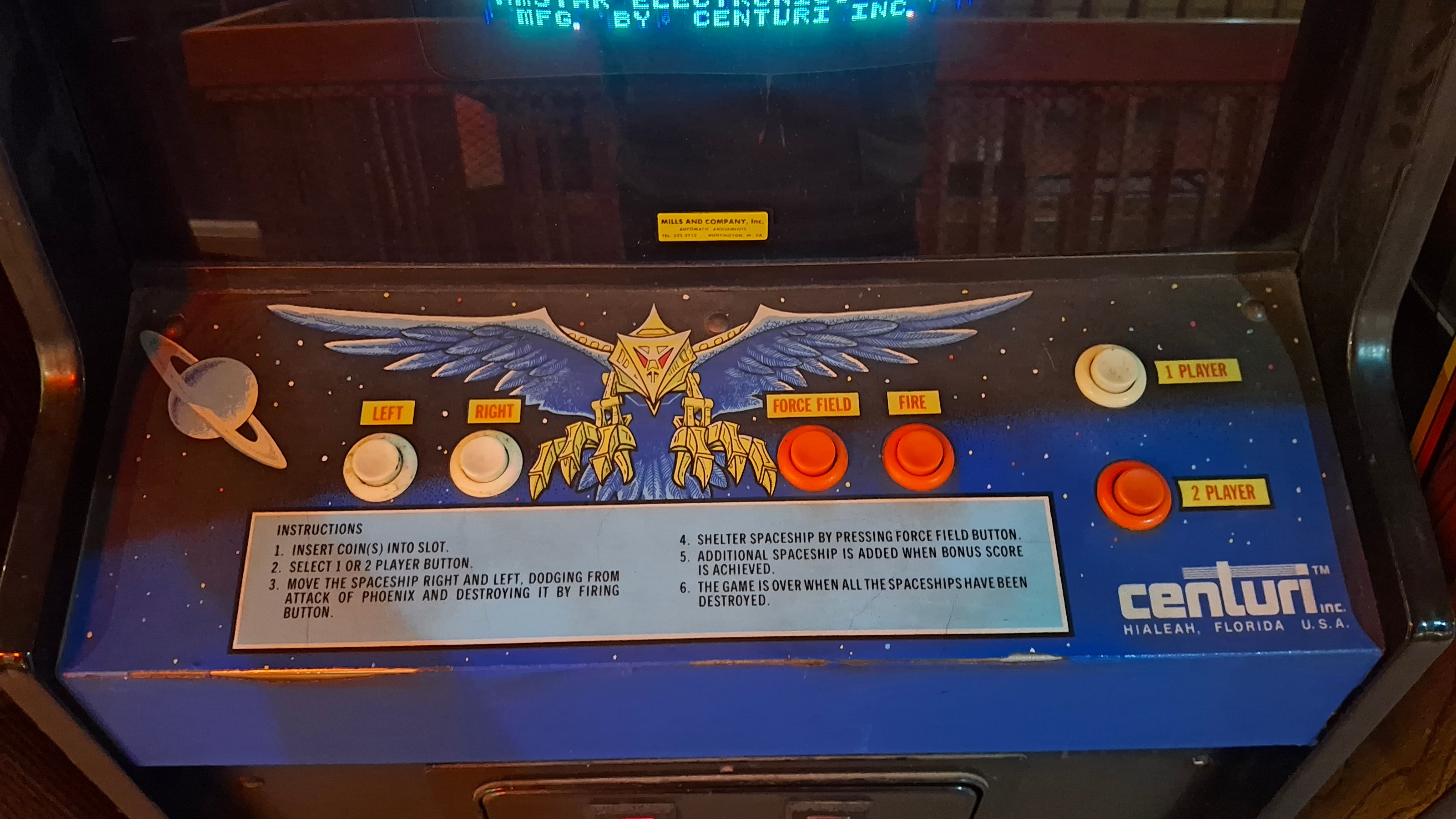
A Centuri Phoenix cabinet, located at the American Classic Arcade Museum in Laconia, New Hampshire.
If you’re not used to the Left-Right buttons in place of sticks or a directional pad — and why would you be in 2026, unless you already had years and years of exposure to and experience with them — it can be a little disorienting at first. Even for myself, despite my immersion into golden-era arcade cabinets over the years, it tripped me up for a bit — it’s all those Namco games with their joysticks that I played that kept this from being an instantaneous transition back in time. A couple of quarters later, though, and my brain was rewired as needed, to the point I was able to get through a full loop and see what Phoenix had to offer beyond the initial couple of stages.
The first two stages have smaller bird-like vessels coming at you in significant numbers, and right out of the gate: again, this is not like Galaxian, but more like Galaga after it’s ramped up the difficulty a bit in terms of the volume of foes coming your way. Only — and this is important for the premise you’ve been reading for a bit now — it predates Galaga’s aggressiveness by a calendar year. In the first stage, you fire more slowly, dodging both ships and their fire, but in the second stage rapid-fire is enabled so that you can do the same thing but with better defense. Yes, defense, not offense: the ships are coming at you even more aggressively here, so you’re more fighting back instead of taking the fight to them. There’s a scoring trick here in these first two stages, as well: if you can hit a basic bird ship coming at you while it’s moving diagonally instead of coming straight down at you — a more difficult shot to make that involves better timing and movement tracking — you earn 200 points rather than 20. More advanced Phoenix spaceships — those are the bird-like ships you’re fighting — can be worth more base points, as well.

Phoenix received an Atari 2600 port that had to make cuts to the game, as well as downgrade visually, but it remained a popular pick in its day. Image credit: MobyGames
Stages three and four feature a wave of bird eggs rather than a formation of bird ships: these eggs will inevitably hatch into larger birds that can also fire shots at you, just like the ships — if you can quickly destroy the eggs before they hatch, they will be worth more than the enemies that come from them, which makes the entire setup basically the opposite of the patience approach that Galaga ended up going with in order to force you to find scoring tricks by not just firing continuously and at random, or before the formation was set. These hatched monstrosities are significantly different than the ships more than just visually, as you can hit the left or right wings of the birds and not actually destroy them. The wings will eventually regenerate, as well; your focus has to be on the center of the bird to end the threat, which puts you right in line with the shots it’s firing at you. Finally, the fifth stage of the loop is the boss, where an alien pilots a massive ship. You fire repeatedly through the ship, blowing away more and more of its exterior, until you get to a scrolling belt that takes damage. Once you’ve cleared enough of the belt away and have an open shot at the alien piloting the thing, you can clear the stage with a single hit of it. It’s not as simple as that, of course, as bird ships from the earlier stages are counterattacking you at the same time that the boss ship itself is shooting, causing you to have to dodge fire while you send off your own. Getting rid of all of the bird ships also doesn’t solve anything, since another wave will just be launched by the boss ship.
The loop then repeats, only more difficult this time. To help you actually complete a loop (and then further ones), you have more than just your offensive capabilities, but also a force field with a dedicated button. This won’t protect you from ships that come down and crash into you, but it does absorb enemy fire. So, if you’re quick enough, you can repel an incoming fiery death, but you can’t just spam the force field button, either. And while you can shoot while under the protection of this temporary shield, you’re stuck in place. Given that enemies can just crash right into you — and absolutely seek you out and hang around at the bottom of the screen basically taunting you with the knowledge that they can get you but you can’t get them at that time — you do not want to leave yourself open to that possibility more than you need to.

Only one way to get an eggscellent score in Phoenix. Image credit: MobyGames
Phoenix was successful and different enough at the time that, like with Space Invaders and Galaxian, it found itself with a legion of bootlegs and clones rather than being considered one itself. Atari even ended up suing Imagic for their game, Demon Attack, as Retro Gamer detailed back in 2016 (issue No. 161). The issue was copyright infringement: Atari was protecting their exclusive license to produce Phoenix for the Atari 2600, but the two parties ended up settling and Imagic was allowed to release the game all the same, despite the attempt at an injunction.
Despite Phoenix’s success and popularity in its day, it’s been mostly forgotten about. Not by people who enjoy playing it, but in terms of being available to even discover or rediscover. Taito reissued it exactly one time, as part of its Taito Legends collection that released for the Playstation 2, Xbox, Playstation Portable, and Windows back in 2005. Taito has not, however, put it on any of their other compilations, or added it to the Egret II Mini console in any way, and Hamster has yet to include the 1980 fixed shooter as part of its vast Arcade Archives lineup, as well. Its port hasn’t made its way to the ever-expanding Atari 50 suite of games, either; you either play this one on a cabinet if you find one, happen to have the means to play its re-release from 2005, or you emulate in MAME. That’s a surprising turn of events, considering how regularly Taito goes to its deep library of games — including its deeper cuts — and how Hamster has had no issue releasing notable games that far more people have forgotten about than remember.
Given that Taito keeps digging, though, and Arcade Archives continues to mix plenty of 1980s in with its more recent shift to the 1990s, maybe this will all change and Phoenix will once again do that thing that phoenixes are famously known for. Maybe by then we’ll even know who is responsible for developing the thing.
This newsletter is free for anyone to read, but if you’d like to support my ability to continue writing, you can become a Patreon supporter, or donate to my Ko-fi to fund future game coverage at Retro XP.
Reply