- Retro XP
- Posts
- Retro spotlight: Resident Evil
Retro spotlight: Resident Evil
Not the first horror game, no, but certainly the one that defined the genre and its possibilities.

Marc Normandin
April 03, 2026
This column is “Retro spotlight,” which exists mostly so I can write about whatever game I feel like even if it doesn’t fit into one of the other topics you find in this newsletter. Previous entries in this series can be found through this link.
The list of games more influential than 1996’s Resident Evil is a short one, but it has its own influences — Resident Evil did not simply spring from the ether, fully formed. These influences came from games, of course, but also cinema, and while not everything about Resident Evil was necessarily original, no game before it had combined all of its disparate elements together so successfully: Resident Evil ended up defining horror games, and popularizing the term “survival horror,” specifically, for a reason. There was plenty that Resident Evil was like, but there was nothing like Resident Evil.
Alone in the Dark is one of the obvious comparisons, given that it, too, took place inside a mansion, and used fixed camera angles and 2D backgrounds with 3D objects and characters. As far as gameplay goes, however, Capcom’s vital hit pulled more from one of its own, Sweet Home. This 1989 Famicom release, helmed by Ghosts ‘n Goblins creator Tokuro Fujiwara, was a licensed adaptation of the film, Sweet Home, which took place in a mansion with a crew of five filmmakers. They had limited health and ammunition, and you were attempting to get as many of them to survive the mansion’s horrors as you could. Inventory management was key, there were quick-time events before there was a name for that sort of thing, and there were even multiple endings. Whether you have played Sweet Home or not, that should all sound familiar.
The genesis of Resident Evil was in Fujiwara wanting a remake of sorts on more powerful hardware — while Sweet Home was groundbreaking and obviously great, it was also attempting to be a horror game on an 8-bit system. The idea was that something truly terrifying could be made with more advanced technology, and that seed was planted during the time of the Super Famicom. Jumping to 16-bit hardware wasn’t quite right either, however, but when 32-bit systems like the Playstation came around, that changed everything for the very small development team… one that was basically just Fujiwara’s handpicked lead for the project, Shinji Mikami, in its earliest days.
Image credit: MobyGames
Why Mikami? As Fujiwara explained in a 2009 interview, it’s because Mikami admitted that he hated being scared. “If he’d answered that he never got scared, I couldn’t have trusted him with the project. People who aren’t afraid of anything don’t understand what’s frightening. In my view, you can’t make a horror game if you don’t have any fear.”
Mikami’s vision for the game changed continually during those first months — at first, a game in a haunted house was the idea because he was, by his own admission in a 2010 interview with Now Gamer, scared more by ghosts than by anything else. As the ideas for combat started to come together, though, Mikami realized that zombies were a better bet. This switch from haunted house full of ghosts to zombies wasn’t the only major change in those early days, though. Resident Evil, as originally conceived, was going to be fully 3D and played in a first-person view. The problem was that the “quality of the graphics was reduced,” which mattered significantly for Fujiwara when you consider that the idea behind this project in the first place was to remake Sweet Home, conceptually, on more powerful hardware that would result in the definitive horror video game. Per Fujiwara, in that same 2009 interview, “The basic premise was that I’d be able to do the things that I wasn’t able to include in Sweet Home. It was mainly on the graphics front that my frustration had been building up. I was also confident that horror games could become a genre in themselves.”
This is where Mikami’s appreciation for Alone in the Dark came into play, and why Resident Evil switched from a first-person perspective to fixed camera angles, as well as from fully 3D to 3D objects and characters but with high-fidelity, pre-rendered 2D backgrounds. Those who have stuck with Resident Evil into the present will recognize that the series eventually did go not just fully 3D — that happened even before the end of the fixed camera angles, with spin-off Resident Evil - Code: Veronica — but also delved into first-person and its “subjective” view of the world with Resident Evil 7: Biohazard. But wait, there’s more: an early version of the game, per Now Gamer, actually used an over-the-shoulder view, which Mikami would return to for another genre-defining classic in Resident Evil 4, but for similar reasons ditched that plan when it became clear that either the Playstation could not deliver the intended experience or Capcom just wasn’t able to figure it out at that early stage of development on the system. Capcom got a whole lot of mileage out of the early idea stage of Resident Evil development, huh?
It’s difficult to argue with the choice to go with the fixed camera angles in the end, as they certainly had the effect that Mikami, Fujiwara, and the rest were hoping for. Resident Evil is often referred to as “cinematic,” which is because of the control that the fixed cameras allow for the developer to have even after releasing the game into the wild and into the hands of players. There are “filmic” shots, which help to set up hidden scares while forcing players to analyze environments from the points of view allowed to them. The zombie you can only see coming up behind you in a hallway by noticing it shambling in a mirror in front of you? There was only one way to make that work, and it was by forcing that angle onto the player and not giving them control over it.
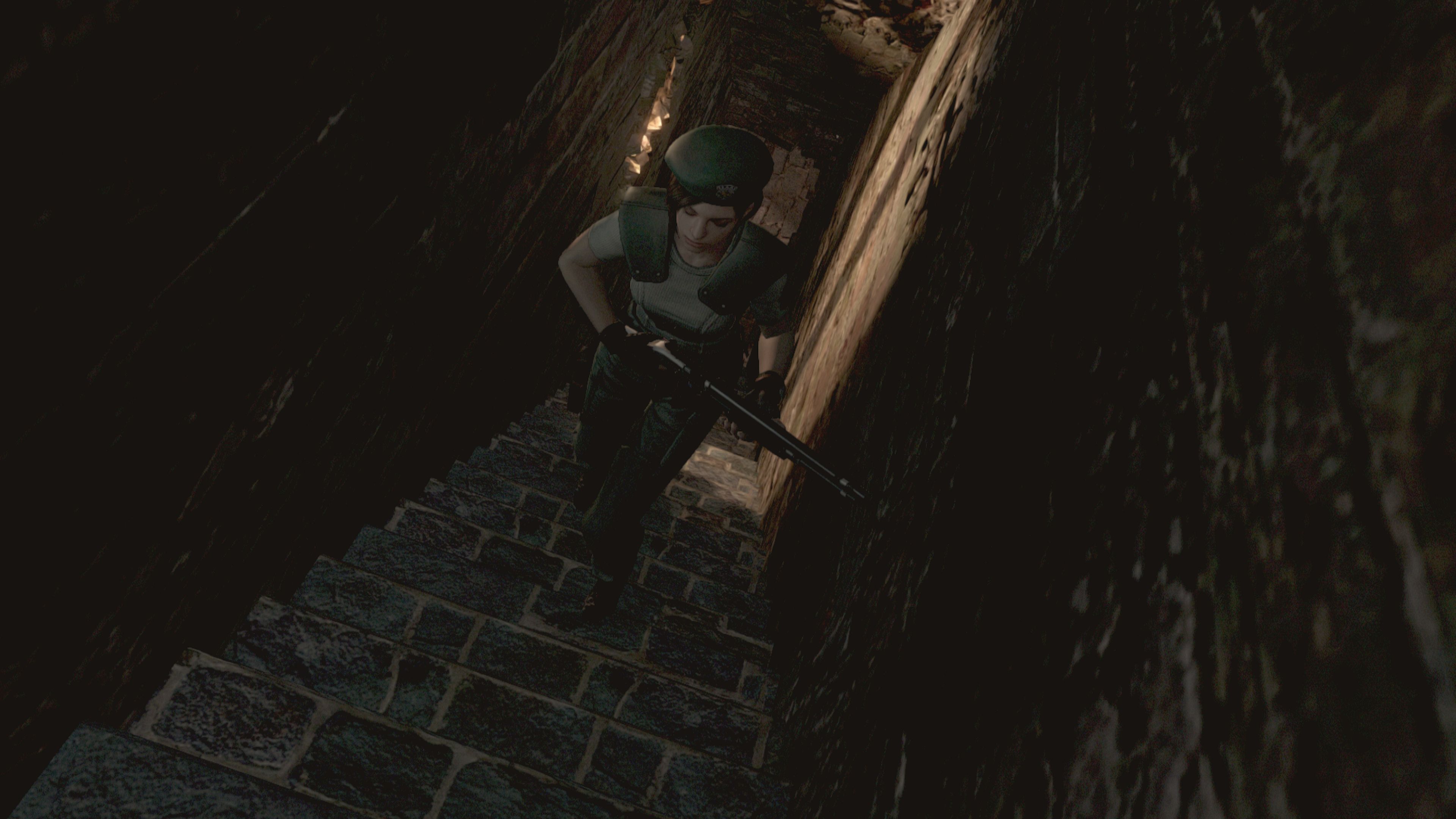
The fixed camera angles — which carried over into the Resident Evil remake on the GameCube, seen here — allowed Capcom to play with tension and pacing in a way that would not have been possible had the player been able to swing the camera around to wherever they felt like.
Jump scares were not the point, though — Resident Evil was far more than “just” sticking a hidden zombie around a corner you could not see so that it would surprise you. No, what made this work was that you knew you couldn’t see around the corners, could not cheat with a camera you controlled to get a glimpse of said surprise before your character could. It was the knowledge that there could be something hiding back there that upped the tension and filled you with terror, and discovering you were correct to be so concerned was what made you jump. In Philip J Reed’s Resident Evil, published by Boss Fight Books, he describes such a scenario, and how Capcom plays with expectations to cause you to fear for safety throughout. First, following the introduction of the idea that this mansion isn’t empty but is instead full of monsters chewing on humans, you walk down a long hallway, nervous about what you might find next. The answer ends up being nothing — maybe you’re a little relieved at this, at not finding another zombie looking for its next meal behind every door, and since the fixed camera angle allows you to see everything in this hallway, you know that there is nothing hiding anywhere like there was when you bumped into that first foe.
Capcom uses that temporarily relief against you, though. As Reed explained:
Walk a bit farther down the hallway and the camera shifts to an angle behind you. Now you can see all the way down the hall. Perhaps there’s something around the corner, but until that corner, at the very least, you’re safe. There’s nothing up this sleeve, either.
So you advance, and a dog crashes through the window behind you.
This is unfair. This is not the way the game is supposed to work. Rooms might contain enemies, but they can’t suddenly be invaded by enemies out of nowhere. This is a game. Games have rules. You escaped the dogs by entering the mansion. Dogs prevent you from leaving through the front door. These are outside dogs. They aren’t allowed in the house.
But this dog doesn’t care, smashing the boundary between one part of the game and another in a shower of broken glass, leaving you to deal—now—with the repercussions.
The camera foregrounds the dog during its entrance. You might watch it stumble and slide across the floor, forgetting that this isn’t a cutscene and you aren’t safe.
…
You panic. You run.
…
At this early point in the game, Resident Evil knows you’re still getting used to things. That’s why the hallway is straight, narrow and empty. The design of the area ensures that when the dog crashes through the window, you’re already moving away from it. You don’t have to grapple with a decision; psychological inertia will keep you moving forward. A lot faster now, but still forward, no longer worried about what might be around that corner, because you’re focusing on what’s definitely right behind you.
And so you turn the corner, and the camera reveals, for a fleeting moment of desperate relief, that there’s nothing there waiting for you.
…at which point a second dog crashes through another window up ahead.
…
The dogs … could have been a cheap jump scare. But jump scares give the audience its fifteen seconds of surprise and no more. Resident Evil knows better. It knows that scary isn’t scary enough. The developers took the inherent shock of a monster crashing through a window and gave us the most lovingly constructed horror movie sequence that was never actually in a horror movie.
The dogs didn’t scare you. Capcom did.
This knowledge that anything can happen, at any time, that you might not be safe even when you think you are safe, haunts you more than any actual single foe in Resident Evil can. You never know what might happen next — especially after it becomes clear that the camera can lie to you about what might happen — but you can sure imagine and feel anxiety over the possibilities, which, after this sequence with the dogs, you know are limitless. The original Resident Evil taught you to fear walking by windows, and that closed doors could eventually be forced open by a zombie working at it long enough — these became clear signs of concern as you entered or reentered a space. Which in turn led to Resident Evil 2 upping the ante by having monstrous Lickers climbing on ceilings where you might not initially see them, and the invulnerable Tyrant, Mr. X, straight-up smash through walls that gave off no such indication that they could be busted through like doors and windows, and at seemingly random intervals. Creating this environment where you must expect the unexpected makes it difficult to reduce the tension — your character has to survive the horrors of the mansion by pushing ever-forward, but you do, too.
The game is loaded with teachable moments that explain its rules — and yes, the game then “breaks” those rules, as Reed described, but knowing them is still important. The first zombie revealed to you in Resident Evil is deployed similarly to the first Goomba in Super Mario Bros. over a decade before: it’s there to explain to you, in a playable tutorial without text, how the game works. Like running right into the Goomba and dying, sure, you can pump that zombie full of bullets once you regain control and realize it is mere feet away from you in a small room. But that will teach you that oh man, these zombies take a beating, and oh no, I only had 15 bullets and now I have far fewer. This is where Resident Evil teaches you that your weapons are not designed to be highly effective. They're for delaying your own death more than dealing it to others, and any weapon that does make for efficient killing is lacking in ammunition to the point where you probably want to just hang on to that for whatever unknown horror awaits later on.
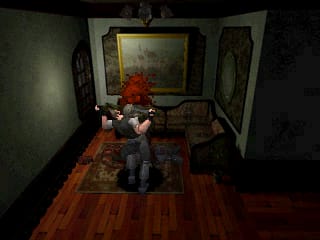
Chris Redfield learning a valuable lesson against the first zombie in the game. (Image credit: MobyGames)
Which leads you to the next possibility in this initial encounter: you can also just decide to ignore this monster entirely rather than risk it — in Super Mario Bros., this would mean jumping on the platforms above, which are introduced at the same time as that initial Goomba, and in Resident Evil, it means turning back in the other direction and running from the zombie. In both instances, you can deal with the enemy after powering up if you prefer to run only to live to fight another day: for Mario, that means finding the nearby mushroom power-up that allows him to grow in size and defensive capability, while for Resident Evil it means coming back to the room after you have more than 15 bullets on your person — after you even know there are more bullets to be had.
One key difference, though, and another instance of Resident Evil breaking player expectations, is that if you ignore the Goomba in Super Mario Bros. and move forward, it is no longer an issue — that Goomba is as good as dead, since it can’t come back to harass you further due to the way the game’s scrolling operates. In Resident Evil, though, that zombie is still there. And it might even be walking around its space within the mansion a bit, waiting to surprise you in a slightly different place than where you left it.
In the 2002 remake of Resident Evil released for the GameCube, this idea goes even further. The zombies aren’t dead when you kill them. Instead, leaving a downed zombie alone for too long means it will become a high-powered version of a zombie, a “Crimson Head,” which has a red tint and now moves and recovers faster, and requires even more bullets to put down. This happens to every zombie in the game, if you don’t destroy its head or set it on fire before it converts. If Mario stomped on a Dry Bones and then it came back even more powerful and violent unless he doused it with kerosene and then set it ablaze, well, that would be the zombies of the GameCube remake of Resident Evil. And in this scenario Mario also doesn’t have enough ammunition — or kerosene — to do this to every Dry Bones he meets, meaning that he has to make decisions that balance short-term solutions against the long-term problems they can create; is this hallway one where you should leave a bunch of future Crimson Heads lying around, or would you be better off ridding it of them for good at the expense of clearing out a different hall or room you will have to pass through later? Running was the answer when those two dogs flanked you after crashing through windows in the original, but in the remake, running could very well cause more problems for you in the future. Unless running is the right answer once more, anyway — good luck constantly asking and re-asking that question while death shambles toward you, by the way.
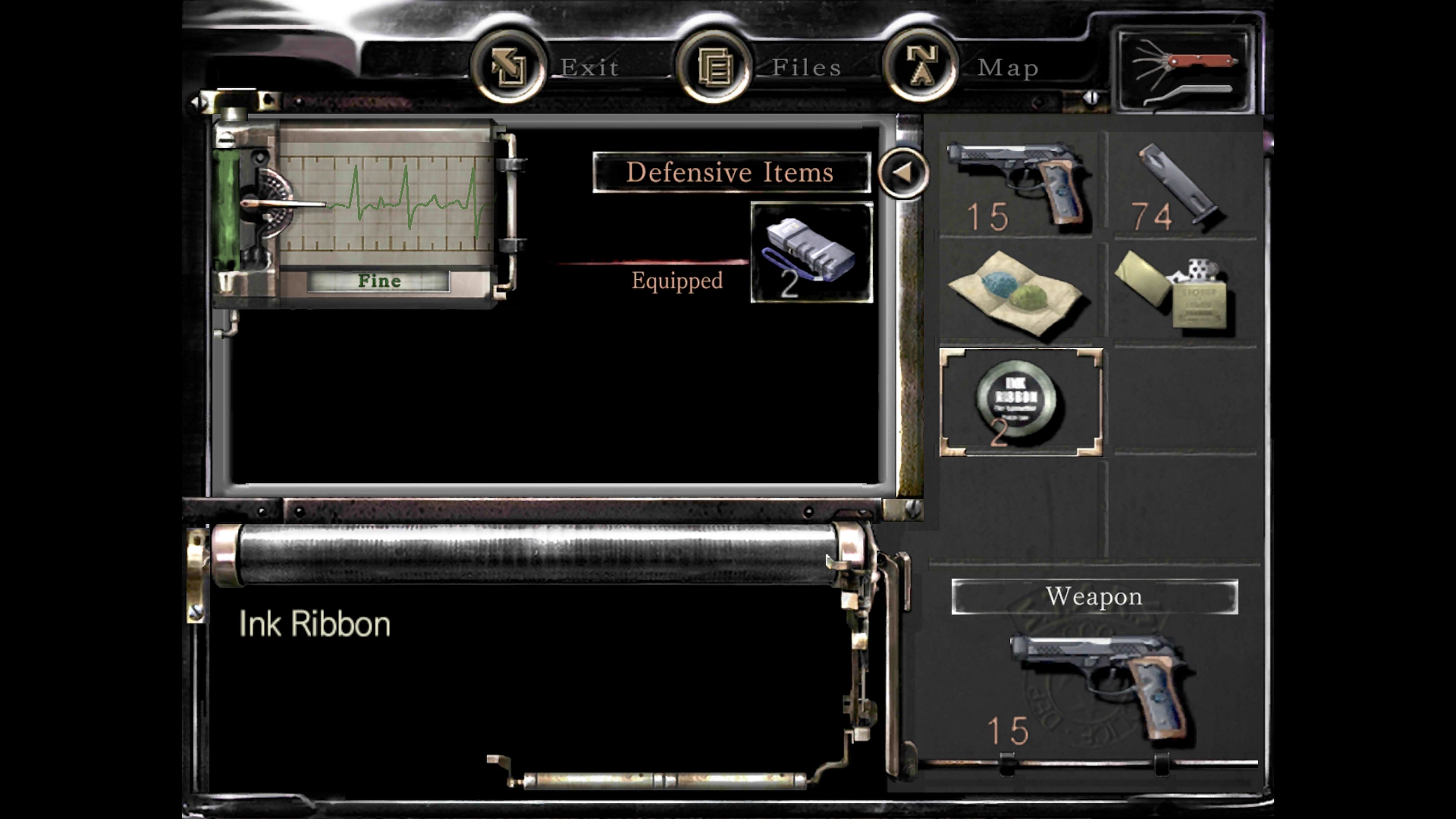
Differences in characters are significant; Jill not only has a lockpick that allows her access to a number of doors that Chris has to find the actual key for, but she has additional inventory spaces that allow for cutting down on backtracking. Which is even more important in the remake, thanks to the “Crimson Head” zombies.
Having to figure all of this out further enhances the idea that the mansion itself is a character — sure, you get to know the members of S.T.A.R.S., an elite unit of the Raccoon City police department that is investigating a series of strange murders in the woods by the city, and Resident Evil’s plot and the introduction of the T-Virus and Umbrella does take center stage right alongside the terror it instills you with if you bother to investigate the many notes and clippings left behind by its previous inhabitants when they were still capable of writing sentences that went beyond “Itchy. Tasty.”, but it’s your ever-developing knowledge of the mansion and its idiosyncratic nature and secretes that will stand out more than anything Jill Valentine or Chris Redfield can do or say. It’s a living, breathing, reactive thing, and it is as terrifying as much as any foe you find within it. So much of the game is figuring out efficiency and testing your memory, and if you don’t recall where you left a zombie or an item you could not pick up because of inventory concerns, or where the nearest safe room and save point or health recovery item is, well, you won’t make it through the night in Oswell Spencer’s mansion.
While Sweet Home and Alone in the Dark were obvious inspirations in terms of both presentation and gameplay, Mikami’s desire to do what movies like Dawn of the Dead could not do, due to not being interactive experiences, led to the choice of zombies and the situations that presented themselves in the mansion. As he explained to Now Gamer: “Yes, I thought – zombies! At that time I recalled the film, Dawn Of The Dead; I loved that film. It was unfortunate, as far as the audience was concerned, that they couldn’t survive; but with a game, the players could use their own techniques and thinking in order to survive the experience.”
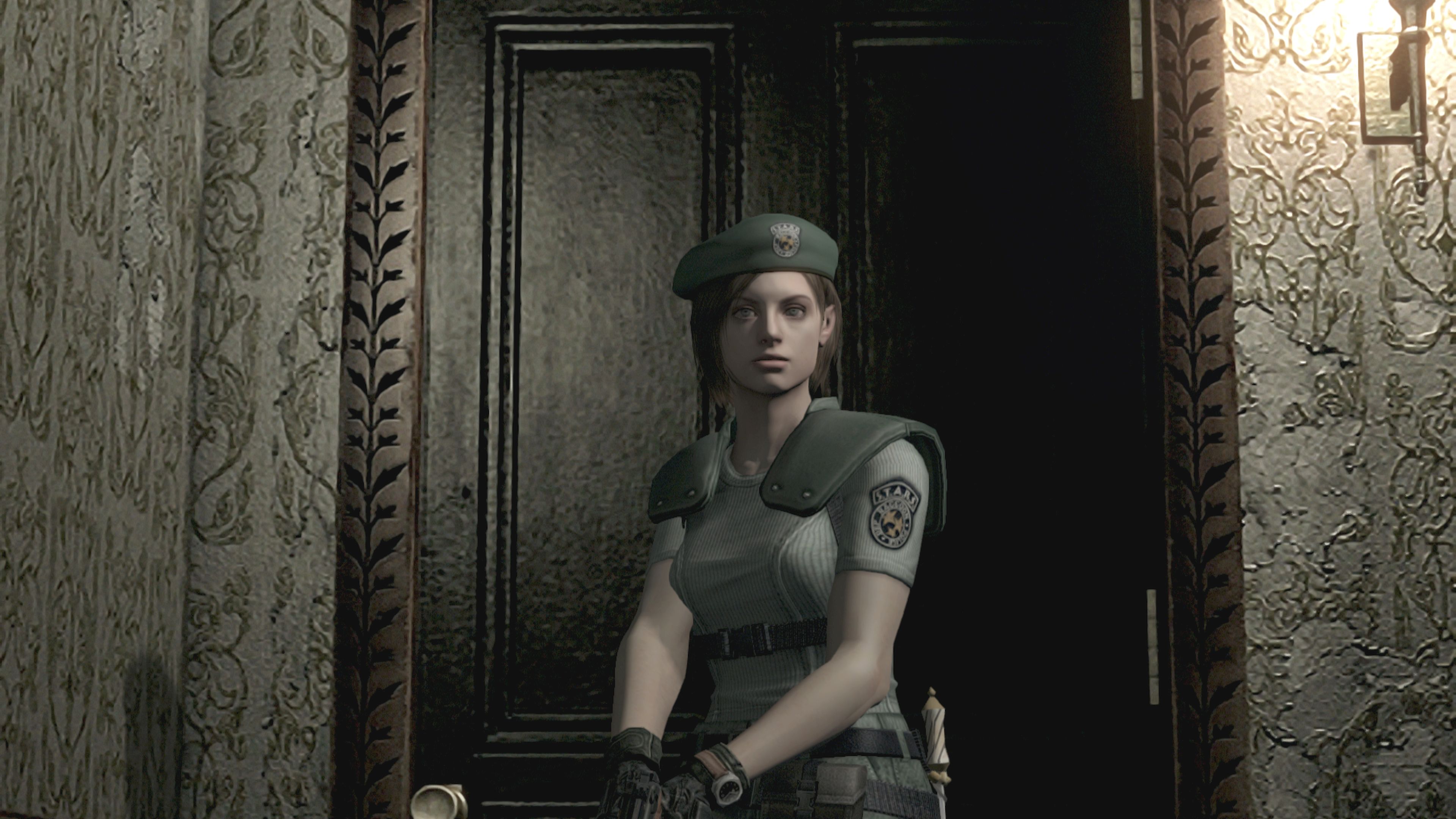
Jill enters through a door, and you are greeted with this close-up view of her face, and no idea what she is looking at. That’s fixed camera angles at work.
Mikami continued: "I thought that this difference between horror games and horror movies could be something wonderful. That was the moment when I conceived Biohazard.” And to Gamespot in 2016, Mikami elaborated further, saying, “At one point during development, I thought about how exhilarating it was to take down a zombie and about how that was a feeling that you just couldn't get from watching a movie. That was the first time that I really sensed that we had a new genre on our hands.” The difference between “horror” and “survival horror” jump out here, when it becomes clear that the initial concept was the fact that the player could take matters into their own hands here in a way that wasn’t possible watching a movie. Mark Wahlberg’s “If I was on that plane it wouldn’t have went down like that” dream made reality, only with zombies and a mansion and not the unearned confidence of a guy who gets paid to pretend to be an action hero for a living.
Another inspiration for Resident Evil? Adventure games. Resident Evil is loaded with puzzles, sometimes with obvious solutions and sometimes opaque. You’re required to think outside the box with item after item, and recall that thing you picked up and didn’t understand and shoved into your item box in a safe room later on when hey, that shape on the wall looks a lot like an emblem, or, oh, so that’s why I need a broken shotgun. The adventure game bits go beyond just puzzles and inventory management with a lack of hints and some expected trial and error, plus plenty of embarrassing instant-death via unexpected failures. Sweet Home had plenty of this going on as well, of course, so Resident Evil is simply carrying on that lineage into an unlicensed future, but it’s still incredible just how much of that genre’s deal made it into the Playstation era, to the point that you can’t just walk up stairs in the original Resident Evil. No, you have to press a button near stairs to use them and then your character climbs to the top on their own — if that’s not the most adventure-game shit you have ever experienced in your life, then you are lying to yourself.
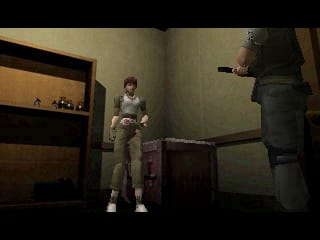
Rebecca Chambers, hiding in a safe room. (Image credit: MobyGames)
It’s not just adventure games, however, fused with a bit of action and what would become survival horror. Resident Evil can lay claim to being, at the least, Metroidvania-adjacent, and doing so at a time that predates the creation of the term. Constant backtracking within a labyrinth, new items required to open up more and more of the world and combat its terrors, incessant use of keys, enemies to kill and enemies to avoid, puzzles to solve and the occasional overpowered boss? Are we talking about Metroid? About much of Falcom’s 1980s output? Or is this Resident Evil? Hey, it’s all three. This isn’t me trying to start up “‘Is Maniac Mansion a Metroidvania?’, the greatest thread in the history of forums, locked by a moderator after 12,239 pages of heated debate,” but also, Resident Evil is one strange blend of elements from a number of genres that came together into something both immediately recognizable and entirely new — it can be many things at once, but in the end, what it is is Resident Evil.
Like with Sweet Home, there are multiple characters and endings. The way it’s setup here is a bit different, however: originally, Jill Valentine was the “easy” mode, given she had access to a lockpick and additional inventory slots, as well as the occasional gift of ammo from Barry Burton, a veteran S.T.A.R.S. member with a secret. Chris Redfield was the hard mode, as he was paired with rookie Rebecca Chambers, a surviving member of S.T.A.R.S.’ Bravo team that came to the woods and then the mansion first — she’s a medic, not a big dude like Barry walking around with a magnum, so interacting with your “partner” as Chris is different than it is for Jill. While that setup still holds true a bit in the remake, there are also adjustable difficulty levels on top of that initial one.
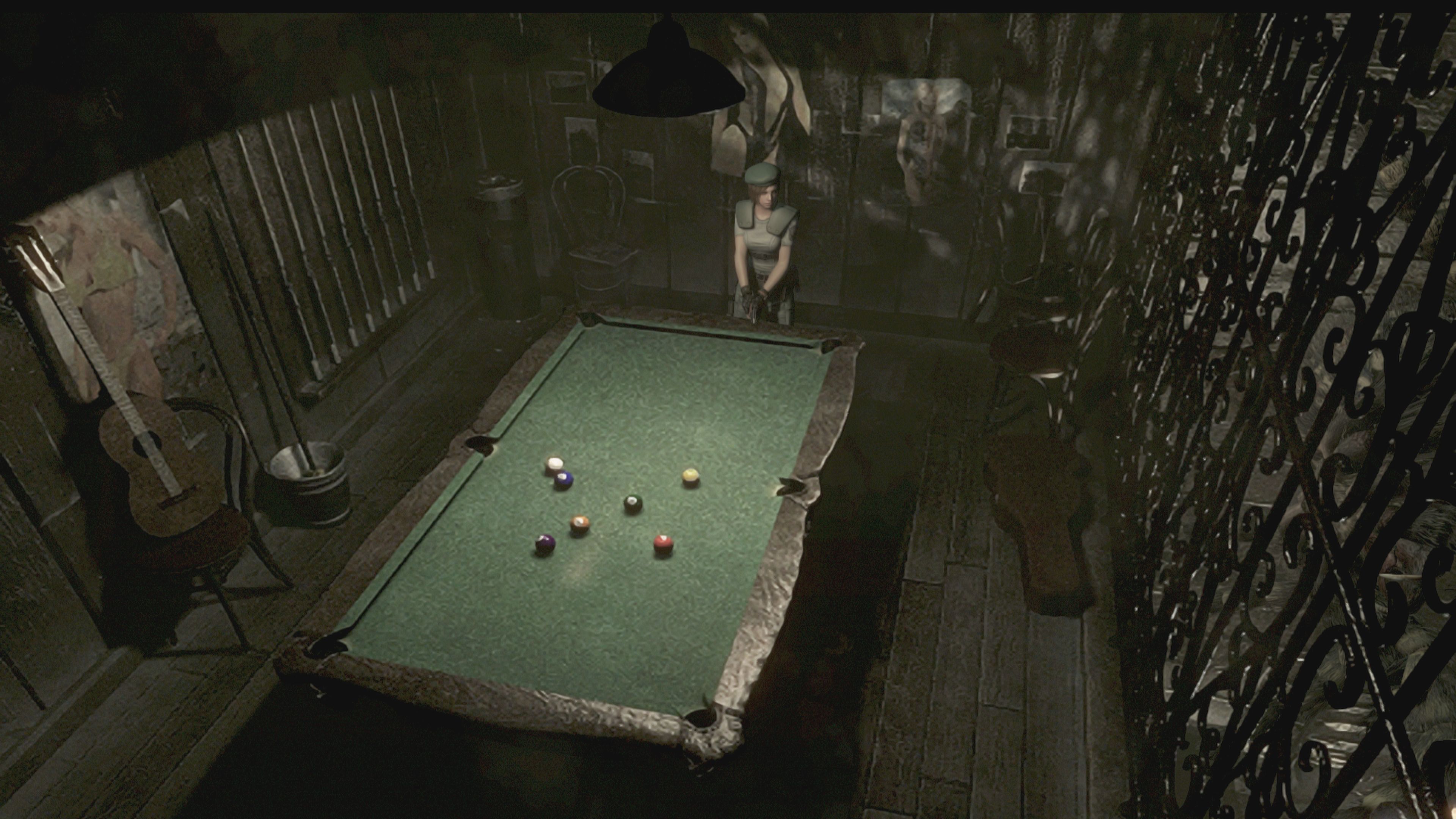
The enhanced visual fidelity of the 2002 Resident Evil remake remains something to behold, even decades after the fact — helped along, at least in part, by its eventual transition to HD, but the fact it holds up so well even with that shift tells you about its initial quality.
Chris is missing in Jill’s playthrough; Barry is the one missing when you play as Chris. Albert Wesker, the commanding officer on the mission, vanishes early, and in a way that might make you forget he was ever there at all. Which, as anyone who has played Resident Evil before (or later entries in the series) knows, is for a reason. There are opportunities to save both Barry and Rebecca or to either fail to do so or to just let them die, and these change the game’s ending; there are also late-game rescues to pull off, where you will find your missing comrade but have to actually set them free — succeeding or failing at this task can also change the ending. This all gives you reason to replay, but so too does this idea that the mansion is knowable and able to be cleared with relative ease when armed with knowledge of its layout and secrets — when you know which enemies you want to use the shotgun against, when you know where the herbs and bullets are, when you have a feel for which passageways are the safest and most efficient to traverse, when you yourself are not an untested rookie facing down the horrors of the Spencer mansion for the first time, then the game begins to feel like a significantly different experience.
One other thing to get a handle on? The controls. Resident Evil’s tank controls were intentional, not an accident, but they were never supposed to be a permanent solution. As Mikami explained in a 2000 interview, “For Resident Evil's controls, I had always intended to improve and fix them someday. However, what happened was the game blew up in popularity before I had that chance. And then, because people had become used to those controls, if I went and changed them it would make people angry… I wince when people tell me that the poor controls in Resident Evil helped contribute to the sense of dread and horror… because that wasn't my intention.”
It wasn’t just the players who decided the controls made the game more frightening, however, but the development team as a whole. As explained in Alex Aniel’s Itchy, Tasty (which is getting a limited 2026 re-release through Lost in Cult), Yoshiki Okamoto, who replaced Tokuro Fujiwara as executive producer on Resident Evil in 1995, had Mikami decide between the “tank” controls or real-time ones as one of his first directives. Builds with both versions of the controls were made, and the development team decided that the tank controls, due to their restrictions and the clumsiness that came from them early on, made for a scarier game. Okamoto told Aniel as much in an interview for the book: “We implemented "Devil May Cry-style real-time controls into a pre-release build, but the game lost its sense of fear and challenge because the zombies were far too easy to avoid.”
The tank controls remained in the 2002 remake, though there were different control schemes as far as mapping buttons went, which at least allowed for a preferred setup for players — there was no avoiding that left and right and up and down didn’t necessarily do what your brain initially wanted them to do, until it had rewired itself for Resident Evil, but at least what you were pressing to aim your gun or reload or stab with a knife or shoot could make more inherent sense to you if you wanted to tweak those setups.
The remake added so much more than just enhanced graphics and control options, though. If Resident Evil was meant to bring the true vision of Fujiwara’s Sweet Home to life, the 2002 remake was what Mikami wanted the original Resident Evil to be, if not for the technical limitations of the Playstation. Entire areas of the 1996 edition of the game that were scrapped in development, like the graveyard, were added back in to the remake. The lighting of the remake, its use of shadows and subtle movements, the way it further enhances the effects of the fixed camera angles and the horror of the game’s enemies, is astounding. The voice acting was redone, as, for the original, it had been entirely in English and intentionally spoken very slowly so that it was understood by the Japanese developers at the recording sessions — developers who weren’t aware that the English script was not exactly Shakespeare, to boot. So, the vibes weren’t recorded over, but the script was cleaned up a bit and the lines re-recorded to come off more intentionally hammy and camp. There was the addition of the Crimson Head zombies, which made Resident Evil into a fresh but familiar experience even for those who had already learned all of its secrets, and entirely new pathways and areas were introduced beyond just the graveyard, as well — it’s the kind of thing that isn’t noticeable at all if the GameCube (or its later HD iteration) are your first go at Resident Evil, but if you go back to the original afterward, you’ll be constantly tricking yourself in a “wait, isn’t there supposed to be a door here?” way.
The original Resident Evil is wonderful, but the remake is the definitive edition of it — it’s not just because of graphical enhancements, either, but the entirety of the package. It’s the version of the game Mikami had originally wanted to make, created with the technology that allowed for it, and after Capcom was no longer in the kind of financial danger that plagued the development of the 1996 classic — the developers had time to get it exactly the way they wanted to, and had the tools to do it, too. As Aniel discussed in Itchy, Tasty, Resident Evil wasn’t just a significant hit for Capcom, but it saved the company: there was a point where things were getting dire enough for the former arcade giant that Resident Evil was actually up for potential cancelation, since no one at the company thought it was going to be a hit, and Capcom desperately needed one. They got more than that: a game that not only successfully proved Fujiwara’s idea that horror games were an untapped, unexplored genre and became one of the most influential in industry history to this day, but was also a commercial smash that spawned a long-running franchise and became a multimedia giant.
If you have somehow never played the original Resident Evil or its remake, if you for whatever reason feel that it’s just too different from its immediate successor, Resident Evil 2 — the Aliens and Terminator 2 to its Alien and Terminator — then push those feelings aside and enter the mansion. It’s exceptionally different from what came afterward, even if how it inspired those games is instantly clear, but it’s a masterpiece in its own right, and just as obviously so three decades later.
This newsletter is free for anyone to read, but if you’d like to support my ability to continue writing, you can become a Patreon supporter, or donate to my Ko-fi to fund future game coverage at Retro XP.
Reply