- Retro XP
- Posts
- Retro spotlight: Wario's Woods
Retro spotlight: Wario's Woods
The final game released for the NES is notable for more than just that.

Marc Normandin
January 21, 2026
This column is “Retro spotlight,” which exists mostly so I can write about whatever game I feel like even if it doesn’t fit into one of the other topics you find in this newsletter. Previous entries in this series can be found through this link.
One of the fun things about Wario — especially early on — is that Nintendo didn’t have a specific use case for the character. So he just sort of shows up in whatever an internal studio felt like putting him in, with no consistency necessary — it all just became who Wario is today in the present, decades later. Wario debuted in 1992 as an enemy of Mario’s in the Game Boy classic Super Mario Land 2: 6 Golden Coins, but he wasn’t out there kidnapping princesses or trying to take over the world, so much as stealing Mario’s house while he was out stopping Bowser from doing those very things. It’s a big castle, Mario, you could have shared it with an old friend in need even if he does smell like garlic.
While created by Nintendo R&D1 and designed by Hiroki Kiyotake, Wario has starred in games developed by nine different studios, and for varying purposes. In 1993, after Super Mario Land 2, he landed in Game Freak’s puzzle-platformer Mario & Wario, dropping buckets on Mario’s head to impede his progress while flying around in a plane sometimes. He ended up as a playable character — in place of Bomberman — in the Hudson Soft-developed but Nintendo-published Wario Blast: Featuring Bomberman!, which in Japan was just Bomberman GB, sans Wario. That was in 1994, which is also when the first Wario Land game — still attached to the Super Mario Land series — came out. That traditional — well, you know what I mean — platformer was handled by Nintendo R&D1, as they turned their villain into a playable protagonist for the first time.
Later that year, with Intelligent Systems at the helm, Wario was a villain once more in yet another genre. This time for taking over the Peaceful Woods. Mario couldn’t be bothered to deal with him, so Toad came to the rescue of the forest and its new signage in his own first starring role, years and years before he’d be ready for adventure after a promotion to Captain. That game would be Wario’s Woods, which Wario was clearly able to take with ease due to his air superiority.
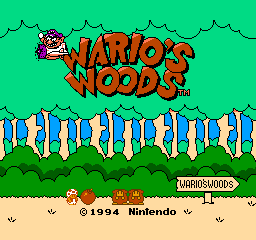
Image credit: MobyGames
If you have never played Wario’s Woods before, you might still know it for something specific: it was the final licensed game released for the NES in North America, on December 10, 1994. It wouldn’t arrive in Europe until 1995, but it had actually come out in Japan much earlier in the year amid a serious rush of Wario titles, in mid-February. That was six months after Mario & Wario, and just under a month after Wario Land: Super Mario Land 3. Because it arrived on the scene much sooner in Japan, it wasn’t the final Famicom game, even if it bore that distinction for the NES: the last licensed Famicom game was Hudson Soft’s Adventure Island IV, which arguably should have featured Wario in order to continue to shake things up in that series even more. Really you could say that about most games, though.
(Of course, “last game” is one of those things that really requires the word “licensed” these days, given how many unlicensed releases exist for classic systems in the present, and for commercial purposes, even. Hello, 2024’s Changeable Guardian Estique. But the actual last licensed game for a system does signal that publishers of the time have officially moved on from a platform, so there’s merit in recognizing those lines, even if they are drawn in the sand to a degree.)
Because of the late release date, Wario’s Woods is also the lone NES game to be slapped with an ESRB rating. It’s a little bit of a coincidence, too: the previous slate of brand-new NES releases came in August of ‘94, when three licensed games all landed in a row to end what had been a very quiet year for the system very much replaced at that point by the 16-bit SNES and the 8-bit handheld Game Boy. Those titles were The Flintstones: The Surprise at Dinosaur Peak, The Incredible Crash Dummies, and The Jungle Book, which brought the NES’ release total in 1994 to all of 11 games. That August date is important, as the first wave of ESRB-rated games came out on September 16, and included the likes of DOOM on the 32X, Super Punch-Out!! for the SNES, and Donkey Kong Country, also for the SNES. There would be no NES games in September, or October, or November, and the only one to be released at all in a world with the ESRB in it was Wario’s Woods. So, it’s the lone NES game to pull a rating — it landed “Kids to Adults,” by the way, the predecessor of “E for Everyone”.
All of these little historical bits obscure that Wario’s Woods also released for the SNES, with 16-bit graphics, different sound, and also some differences in gameplay. What also obscures that it came out on the SNES is that Nintendo basically pretends that it did not. Because Animal Crossing on the GameCube included playable NES games, Wario’s Woods’ NES release was the only option. Later on through Virtual Console on the Wii, Wii U, and 3DS, however, Nintendo chose to go with the NES edition of Wario’s Woods over the SNES one, and in the present, this trend has continued with Nintendo Switch Online. Why is that? It’s not clear — while at some point you could have assumed that the NES edition was placed on Virtual Console for being cheaper, the NES and SNES libraries being accessed through the same subscription tier of NSO makes that theory pointless in the present.

The SNES edition of Wario’s Woods features more and better-defined colors, as well as detailed backgrounds. Image credit: MobyGames
As for how Wario’s Woods plays, let’s start by saying that it’s very much a game that shows the severe limitations of the term “Tetris clone.” Remember, the “clone” terms were always about a lack of language to describe what you were seeing, which is why every first-person shooter was considered a DOOM clone, all the action-adventure titles were labeled Zelda clones, and anything involving blocks or equivalent thereof falling from the top of the screen to be cleared was a Tetris clone. Even in the case of a game where what’s falling is creatures and bombs, and the bombs are used to blow up the creatures, and also you control a character who physically walks around on the screen picking up said bombs and creatures to place them where you feel like after they have already fallen and touched the ground. Yeah, sure, it’s just like Tetris, whatever. That’s Wario’s Woods.
You control Toad, who will pick up the different colored creatures dropping from the top of the trees that the levels take place within, and plop them down where they can be cleared, either immediately or eventually. Toad can pick up one creature at a time, or a stack of them. He can run up the sides of those stacks, or get underneath pieces to pick them up from there, or hold up a bomb or creature above his head to get it in line for a clear somewhere you otherwise would not be able to reach with it. There are a number of little tricks to picking up pieces and moving Toad around and manipulating the environment, and you can learn them all through the Lessons mode, which details the various moves you can learn, lets you practice, and teaches you about Diamonds.
There are “A” moves, which are performed, as you probably could have guessed, with the A button. These are basically just the kinds of moves you can make to drop pieces into place to cause a clear, which requires three “blocks” of the same color in a row, side-to-side or vertical or diagonal, that includes at least one bomb. It shows you every possible move you can make with a grab and drop using the A button, including running up the side of a stack of creatures until you get to the piece you want to grab, which lets you, say, have Toad lift a specific color of creatures from a pile to be placed on the same color creatures or bomb elsewhere to clear them.
Then there are “B” moves, which use the B button and are less about grabbing entire stacks of creatures and more about grabbing singular creatures at a time. Press B to grab the creature in front of you at the bottom of a stack, instead of the entire thing — this lets you get a specific color in hand, but also has what was on top of said creature fall a level. You can create combinations where they didn’t exist if you’ve got an eye for these potential scenarios, where ripping a single Jenga piece out causes the whole thing to crash down in a way that’s productive instead of game-ending, basically.
You can also “Kick and Clear,” which involves holding down on the D-pad and pressing A — Toad will very literally kick whatever piece is directly in front of him and send it flying across the screen until it’s stopped by another piece. This is a more advanced move you’ll find yourself performing later on in order to more efficiently clear groups of creatures and bombs when there isn’t as much time to pick up a specific piece, move Toad, and then drop that piece where it can best be deployed. Boot it right across the screen to that same place instead when you can.
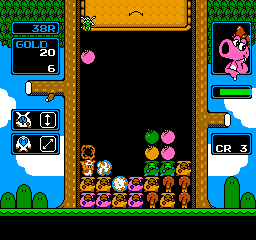
Requirements for clearing specific enemies are shown on the left side of the screen — here, one kind of enemy needs diagonal clears to be removed. Image credit: MobyGames
You can also press up on the D-pad and then press the A button to drop whatever piece you’re holding directly underneath you. You can walk right off of a stack holding a necessary color above you, and, while falling, line those pieces up so that they clear. You can clear multiple colors at once by setting up combos. And, most importantly for later on, you can clear five pieces in one go and earn a diamond of that color. While Diamonds can’t be picked up — Toad has a little struggle animation for when he attempts to move on — you can bring pieces to those Diamonds to clear the whole thing. Diamonds are a necessity as the game increases in speed, complexity, and the number of creatures, as clearing a line with a Diamond instead of with a bomb — a Diamond is the only scenario in which a bomb is not necessary for a clear — will eliminate every piece of that color.
The goal of each level is to clear it fully of enemies. It’s fine if there are bombs remaining in the play area at the end, so long as there aren’t any creatures still sitting there animating in place. Toad can die if he’s trapped beneath creatures, but you just lose a life when this happens — additional lives can be earned with 30 coins, the number of which you get at the end of a level is determined by your performance within it. Some creatures will require multiple blasts to clear, while others require a specific kind of clear, like a diagonal one. The ceiling will drop down when Wario and his bird buddy Pidgit show up, and you don’t want it to fall too far or it limits the space you have to work with in your play area.
What you’ll face also depends on what game mode you choose. The Round Game has two modes, an A and a B, and the B has boss fights within it. The A mode goes from level 1 to 99, and just ramps up the number of enemies, enemy types, and how many colors of those enemies are within as you go, but the B mode has bosses that will defeat Toad if they touch him. Which is a pain sometimes, as the bosses materialize and dematerialize and rematerialize, and if the latter happens on Toad, well. Hope you had some extra lives stored away. Earn clears while the boss is fully materialized to cause damage to it; after you take away all of its hit points this way, you can move on.
There is also a Time Race mode, which sees you pick four different levels at three different difficulties, while trying to clear them fast enough to earn specific ratings. Clear the whole slate of Hard levels in 18 minutes or less, and earn a Gold, that sort of thing. And then there’s the Vs. mode, which makes things like Diamonds important again since a clear with a Diamond will drop junk on your opponent’s side — it’s a different way of playing, but also the same strategies you’d use to clear things quickly and effectively in single-player can work here, since you’re still racing against a clock and trying to do so in the most effective way possible.
Wario’s Woods is one of those games that the people who are into it think it’s great and very different than plenty of other puzzlers out there — the wide variety of moves for Toad makes it feel very much like its own thing compared to other puzzlers, especially at the time, to the point you can argue it’s more puzzle-platformer than falling-block puzzle — but at the time the reception was pretty mellow. It wasn’t as good as Dr. Mario, by some accounts, which was a disappointment, but also you could find reviews from people who thought it wasn’t different enough from Tetris, either, which is the kind of thing that will hurt your brain if you dwell on it for too long. For example, here’s a review from GamePro:
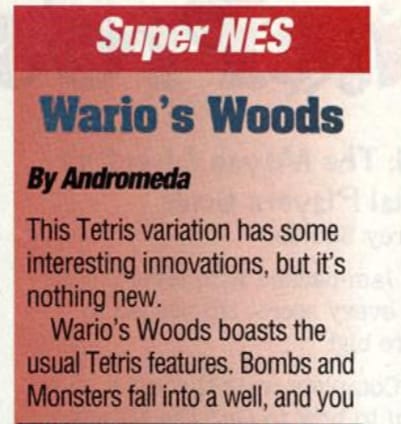
Ah yes, bombs and monsters and Wario, nothing new for [squints] Tetris.
Retrospective reviews have been far more kind to Wario’s Woods, recognizing it as complex, deep, and different from what was around both at the time and in the years since. It’s also one of Intelligent System’s first forays into the puzzle space, which they’ve produced some tremendous work within in the decades since. They would co-develop Panel de Pon with R&D1 on the Super Famicom and SNES, with it known as Tetris Attack in the latter case, and the Puzzle League series that sprung out of this was theirs to maintain. The very underrated Pushmo games are also courtesy of Intelligent Systems, and also have a whole puzzle-platformer thing going on with them, in a 3D space. (Note to self: publicly complain about the lack of Pushmo games available today.)
Wario’s Woods was also Intelligent Systems’ first go at Wario, but certainly not their last: they co-developed the first WarioWare game with R&D1, and have been the co- or sole developer on the WarioWare titles since. See? Wario’s Woods is notable for far more than just being the last NES game, and it’s also still a ton of fun to play in the present, too. Even if it merely boasts the usual Tetris features.
This newsletter is free for anyone to read, but if you’d like to support my ability to continue writing, you can become a Patreon supporter, or donate to my Ko-fi to fund future game coverage at Retro XP.
Reply